What is vertigo? Fear of falling? No, Vertigo is something other than fear of falling. It is the voice of the emptiness below us which tempts and lures us, it is the desire to fall, against which, terrified, we defend ourselves.
-kundera
Wednesday, April 18, 2007

Tuesday, April 17, 2007
Monday, April 16, 2007
There is no means of testing which decision is better, because
there is no basis for comparison. We live everything as it comes, without
warning, like an actor going on cold. And what can life be worth if the
first rehearsal for life is life itself? That is why life is always a
sketch. No, "sketch" is not quite the word, because a sketch is an outline
of something, the groundwork for a picture, whereas the sketch that is our
life is a sketch for nothing, an outline with no picture.
kundera, the unbearable lightness of being
there is no basis for comparison. We live everything as it comes, without
warning, like an actor going on cold. And what can life be worth if the
first rehearsal for life is life itself? That is why life is always a
sketch. No, "sketch" is not quite the word, because a sketch is an outline
of something, the groundwork for a picture, whereas the sketch that is our
life is a sketch for nothing, an outline with no picture.
kundera, the unbearable lightness of being
Tuesday, April 10, 2007
genetics of romance?
from today's nyt
"It so happens that an unusually large number of brain-related genes are situated on the X chromosome. The sudden emergence of the X and Y chromosomes in brain function has caught the attention of evolutionary biologists. Since men have only one X chromosome, natural selection can speedily promote any advantageous mutation that arises in one of the X’s genes. So if those picky women should be looking for smartness in prospective male partners, that might explain why so many brain-related genes ended up on the X.
“It’s popular among male academics to say that females preferred smarter guys,” Dr. Arnold said. “Such genes will be quickly selected in males because new beneficial mutations will be quickly apparent.”
Several profound consequences follow from the fact that men have only one copy of the many X-related brain genes and women two. One is that many neurological diseases are more common in men because women are unlikely to suffer mutations in both copies of a gene.
Another is that men, as a group, “will have more variable brain phenotypes,” Dr. Arnold writes, because women’s second copy of every gene dampens the effects of mutations that arise in the other."
"It so happens that an unusually large number of brain-related genes are situated on the X chromosome. The sudden emergence of the X and Y chromosomes in brain function has caught the attention of evolutionary biologists. Since men have only one X chromosome, natural selection can speedily promote any advantageous mutation that arises in one of the X’s genes. So if those picky women should be looking for smartness in prospective male partners, that might explain why so many brain-related genes ended up on the X.
“It’s popular among male academics to say that females preferred smarter guys,” Dr. Arnold said. “Such genes will be quickly selected in males because new beneficial mutations will be quickly apparent.”
Several profound consequences follow from the fact that men have only one copy of the many X-related brain genes and women two. One is that many neurological diseases are more common in men because women are unlikely to suffer mutations in both copies of a gene.
Another is that men, as a group, “will have more variable brain phenotypes,” Dr. Arnold writes, because women’s second copy of every gene dampens the effects of mutations that arise in the other."
Monday, April 09, 2007
i just read on an old friend's blog that she got an offer from microsoft... it seems that it wan't even that long ago when i first heard her talk about that wish.(actually, that was probably 6 years ago or so.) so dreams DO come true... how exciting. and just the right motivation for me, especially for this week..
life feels great :)
life feels great :)
Friday, April 06, 2007
Tuesday, April 03, 2007
Sunday, April 01, 2007

Saturday, March 31, 2007
Wednesday, March 28, 2007
Escape!
the number "Escape!" from the soundtrack of "The Hours" is exactly Glass' "Metamorphosis Two"! ok, with some orchestration, minimal....
how lazy of Philip Glass.
how lazy of Philip Glass.
Tuesday, March 27, 2007

Monday, March 26, 2007
Thursday, March 22, 2007
Major Book Review: Blood Road
ok here's my term paper for the history class chinese revolution 1911-1949. it came back today so i know there are no major mistakes or misunderstanding. but this is a really good book. chinese, you should read it.
Schoppa’s Blood Road
What a Communist official told the author on the Phoenix Mountain pretty much sums up what most in China or other Chinese communities think of Shen Dingyi. “We don’t know whether he is a good man or a bad man”(Schoppa, 252). One of the most prominent and controversial revolutionaries of the 1920’s, Shen Dingyi was a landlord-turned Communist, who later joined the Guomingdang (GMD). For the decades to follow his assassination in 1928, various names were added to him. Both parties find it difficult in positioning Shen, a man with multiple identities, in the revolution.
In his book Blood Road, The Mystery of Shen Dingyi in Revolutionary China, Schoppa investigates a wide array of materials surrounding Shen Dingyi’s life from late 1910’s to his death in 1928, ranging from historical records, his own writings and narratives from his family and associates. Upon Schoppa’s careful analysis of these materials, Shen’s exceedingly complicated social networks, political positions, ideological influences and actions emerged. In this book, as a result, a humanistic and biographical account of Shen as of 1920’s is presented, and the author’s thesis becomes clear: Because of the causality between a society’s development and an individual’s activities, changes in the society directly influences the individual’s identity, and vice versa, development of individuals determines the course of events in his social context. This is especially true during eras of drastic social and political changes, such as the revolutionary 1920’s in China, and that extremely dynamic and complex society results in an ever-changing face of the individual involved in the process.
With this overarching theme, Shen’s situation seems a little clearer to Schoppa. Since his identities and political positions and actions were an consequence of his social networks, Schoppa puts an emphasis on Shen’s social contacts in his three primary locales of actions, Hangzhou, Shanghai and Yaqian, and effectively reveals the changing sources of his ideologies, identities and his movements in the respective places. Like Shen, Schoppa realized that Chinese tendency of valuing a man’s names more than his deeds often results in oversimplifications and hinders just assessment of historical figures(Schoppa 253). “[I]n the great complexity of revolutionary change, the human mind brings order by naming and holding to that name as the key to the identity of the other”(Schoppa 253). Therefore in his analysis of Shen Dingyi, Schoppa aims to focus on what he actually did in the context of his social networks, such as his leadership in student and worker movement in Shanghai in 1919, his promotion of peasant protests in Yaqian in 1921 and 1928 and his political life in either the Provincial Assembly government of Zhejiang in late 1910’s or the GMD in Hangzhou in mid-1920’s, in order to elucidate the complex dynamics involved.
Shen’s thinking and action in solving China’s social crisis was deeply shaped by his social contacts. The change of social network in 1916 when Shen exiled to Shanghai catalyzed his acceptance of progressive ideologies. Unlike the Zhejiang Provincial Assembly where local elite of the province concentrated on the fate of the province struggling against the aggressive expansion of the Beiyang government, the young revolutionaries whom Shen met in Shanghai were concerned with a wider range of problems. In addition to Shen’s existing anit-feudalism and anti-militarism, he became more conscious of class struggles, women’s emancipation and education, and on a national level (Schoppa 86). The strong influence of Sun Yat-sen’s democratic ideologies and the youths who took part in May Fourth Movements all played a role in his intellectual growth. Identified as a journalist and writer, Shen was proactively working to find a solution to China’s problem, as his writings would indicate. With such inputs, Shen’s output back to the society was much liberated. He wrote for the press extensively about class struggles first and then, at the end of 1919, about a need for reformed social relationships in order (Schoppa 80). In practice, he organized discussion of Marxism where Communism was studied and women had short hair(Schoppa 82). Such actions in turn strengthened the Communists’ progressive presence in Shanghai and altered the intellectual climate there.
Returning to Yaqian in 1920 and coming into contact with the peasants, Shen Dingyi’s social reform thinking was mainly reflected in promoting the peasants’ protests. Applying Marxism, he tried to define the peasants as the proletarians of the countryside and advocated the union between peasants and urban workers to rise against landlords and capitalists. And in his writings, he advocates the ownership of land by the peasants. A network was soon built up, in which he acted as the protector of the peasant class. He encouraged the peasants to organize farmers’ associations and protest against rent collectors and landlords. In the practical endeavor of social reform, strengthened was his relationship with the network of students such as Xuan Zhonghua and Yang Zhihua, with whom Shen built village schools and educated peasant children. However, the protests failed in violent oppression in 1921 and 1922, which Schoppa reasoned to be caused by the influence by the extreme idealism of the May Fourth youths on Shen.
Consistent with Schoppa’s theory, we can also see with a new company and new theory, Shen turned from a local elite member and constitutionalist into a protector of the peasants with a touch of revolutionary thinking. His gentry background might have held him back a little - after all it was a revolution against his own class - but his thinking was very Communist then. After the peasant protests in 1921, although Shen’s political life was little affected by the movement, the failure shocked him strongly, emphasizes Schoppa, as Shen’s writings “betray[ed] considerable guilt, anger, and sadness”(Schoppa 119). In this light, Shen’s ideology in this period was consistently growing more progressive. His complete disregard to landlords’ interest made him target for attack by the rural elite.
With Com-intern's decision for Communists to join GMD in 1922, Shen became a Nationalist, entering a relatively new network in Hangzhou. Under Borodin’s direction in 1923, Shen raised the exclusivity of GMD membership in the way the Communists built their disciplined army, showing his commitment to the new Russianized party organization theories. Naturally Shen in turn made use of the power that he obtained and influenced his social environment by filling the provisional Provincial Party with people from his social network, hence shaping the policy making process. This tightening process of GMD registration and the concentration of power in the province to himself threatened to cause hatred and anxiety, sharpening potential partisan conflicts.
Shen’s switch to the GMD’s side as opposed to the CCP’s side where he came from was not surprising at all to Schoppa. This had much to do with the influence Shen received earlier in his life. Always a fervent follower of Sun Yat-sen’s, Shen Dingyi was genuinely interested in “Three People’s Principle”, even more so than in Communism. His slight reluctance towards class struggle, holding that members from the elite class can be benevolent to the peasants (Schoppa 157), indicated his parting from CCP. This is especially illustrated by his low-key leadership of the peasant protests in Yaqian in 1921. The established exclusivity of GMD and Shen’s complaints about Communist insistence on class struggle and refusal to migrate to Manchuria led naturally to his opinion of abolishing the first United Front. Now, although to Shen himself he was just a Nationalist seeking the best outcome for his party and country, in others’ eyes he was an inconsistent politician fiddling with power. His multiple identities had finally formed in its full complexity. He had enemies in a number of classes and circles, even in his own social networks such as the First Normal circle. The purge was just a trigger, which cut lose any remaining attachment that his old social networks still had with him.
From Schoppa’s narrative, judging from these historical facts combined with the various societal contexts that Shen sequentially put himself in, the course of development of Shen’s ideology and identity was quite consistent and nothing too surprising. Why then, was the assessment of Shen Dingyi all but impossible to do? Schoppa believes that it is because of the Chinese tendency to judge a historical figure by what “names” he is perceived to have, instead of what actual deeds he does. In addition, 10’s to 20’s in China was an era of ideology-mixing and partisan chaos. No viewpoint could be free of self-interest and class influence, resulting in a plethora of inconsistent descriptions of Shen Dingyi, concentrating seemingly disparate names - landlord, Communist, Nationalist, Leftist, Right-wing, revolutionary - onto the one person. This is precisely what makes the interpretation of his identity and the period of history extremely difficult. When comparing materials from a few sources, Schoppa at least solved a number of the inconsistencies.
Firstly, was Shen a local elite, landlord, or a revolutionary devoted to the emancipation of lower classes? Shen has been called all these names, and from his family background, his early political experiences and some aspects of his lifestyle, such as keeping servants, he was indeed a typical local elite in a dying feudal society. However, Schoppa points out that he was an active constitutionalist and reformist, fiercely protecting local government from militarism. Then he felt for the peasants, tried his best to be a protector. He was one of the first people to notice the potential of great power of the rural population in Chinese revolution. With Communist theories, he tried to lead the peasants into class struggle in 1921, and greatly promoted local self-governing experiments and drew up rent reducing documents in 1927. His cold attitude towards his fellow landlords was in stark contrast to that towards the farmers. His writings in this period were mainly singing high praises for the peasant class. In light of such evidence, Li Da’s categorization of Shen into simply “large landlord”(with some enmity) was quite ignorant and unfair. Shen’s hold-back in developing full scale and thorough class struggle came from his position as a member of the elite. To abolish the landlord class is to abolish his own class, his family and his primary social network. This he could not bring himself to do. The conflict within himself is reasonable and is not up to his choice, but a result of social context.
Secondly, his attitude towards militarism also seemed inconsistent, from his boyish love for the martial arts, to his anti-militarism struggle in 1916, to his embracing armed struggle again in early 1920’s. Schoppo shows that in the big picture of intellectual-oriented society in China, Shen’s love for the martial arts indicates something exceptional and revolutionary about him (Schoppa 31). Later during the expansion of the warlord Duan Qirui’s military expansion into the already independent provincially self-governing Zhejiang, the Zhejiang governors sat helpless, therefore Shen’s hatred for militarism seems natural. However, the practical need for military forces when revolution went into full development forced Shen to rethink the value of militarism. Therefore, there was nothing surprising about the his acceptance and even enthusiasm in using and advocating militarism. Again, such choices were a result of events in his social contexts and not so much of a subjective change of mind.
The third problem was his attitude towards Communism, and perhaps is the most puzzling of all. As one of the members of the first Marxism discussion group, he not only became a conservative Nationalist, but also was in charge of the purge of Communists from GMD, turning against all of his friends and associates within the First Normal School network. In 1919, Shen was in desperate pursuit of any strategy that would save the country from the chaos caused by an absence of government. Interaction with the May Fourth worriers naturally led him to both Sun Yat-sen’s theories and Communism. At the earlier stage, both theories were advocating anti-imperialism and anti-feudalism, and the general atmosphere was rather all-encompassing and tolerant. Partly the tolerance rose from incomplete formation of the theories and their lack of thorough understanding by the revolutionaries themselves. In this environment that did not have sharp conflicts between ideologies, Shen was on one hand trying to find a theory that suited him and on the other hand honestly was not bothered by the slight differences between theories. Here the common enemy was external of China, hence what was developed was Nationalism.
Only when political theories matured into full-fledged ideologies and practical power interests were involved between partisans did conflicts starte to appear. Early 1920’s, from the single-minded revolutionary China, partisan power struggles arose. Communists were backed by the Comintern in Russia, and Nationalists had the political and militant power. When the attention turned from foreigners or Manchu rulers started to point against each other, the two parties found fundamental ideological differences. Tolerance disappeared and party members, especially the double party members like Shen Dingyi, were forced to choose a side. And it so happened that his conviction to “Three People’s Principles” and reluctance towards class struggle turned him towards the GMD, and came to regard Communism as rigid. From a “revolutionary”, people’s perception of Shen rapidly turned into “politician” and rumors about him accepting bribes and criticism about him being “opportunistic” (Schoppa 162) rose from the blue. There are also records of him being arrogant, unfair, and unjust, but Schoppa cautions the readers that such documents might very well be forged due to the bitter political competition then. There were also inconsistent with Shen’s history (Schoppa 162). Due to this period in Shen’s life, some people, such as Shaozili, even recalled Shen Dingyi as a Nationalist in his Shanghai period (Schoppa 88), which was factually wrong.
From Shen’s attitude towards Communism we clearly see the powerful tides of a time capable of directing an individual’s life and identity. Not only did changes in the Chinese political society cause changes in Shen’s identity, from Shen’s life in early 1920’s alone, we see the mirrored reflection of the society itself. The loss of tolerance in Shen’s policy in GMD directly reflects the loss of tolerance in the society; and that Shen started to put more emphasis in controlling the party than nationalistic concerns directly reflects a similar trend in the society too. Just like the metaphor used in the poem cited at the beginning of the book, the society was like a mirror where Shen saw himself in. When the society gets fragmented like a mirror gets broken, his identity, which was the reflection in the mirror, gets torn into pieces too. This powerful metaphor demonstrates the nature of identity being a social construct, which cannot exist without society, and instead of being constant, will change violently when the society does so.
Fourthly, whether Shen Dingyi was a Left-Wing or Right-Wing in GMD was even more confusing. Because Shen used to be an early organizer of CCP some conservative Nationalists fixed his identity as a Left-Wing, however, due to his effort in the Purge and differences of opinion, the Communists held that he was a Right-Wing. In fact, it is hard to say whether he was either. His ambiguous attitude towards class struggle and his seemingly active advocacy of revolution(Schoppa 181) both blur the line, and rendered Shen “moderate”(Schoppa 167). Furthermore, the general chaotic and inconsistent situation within the two parties makes even the definition of right and left ambivalent.
There are a few lessons we can learn from this book regarding methodology of historiography. First is causality. Based on all of his analysis, Schoppa makes a number of guesses as to who murdered Shen, and suggested that the most convincing option was the GMD, judging from the tension within the party around 1928. With these guesses and the entire course of analysis in the book, Schoppa demonstrates the reasoning power of historical causality, which remotely reminds us of the philosophical concept of determinism. To show that everything resulted from a trackable cause can result in greater accuracy and eliminate hand-waving arguments.
Secondly, on a related note, Schoppa tones down the importance of individuals’ subjective choices in the course of a revolutionary history, but emphasizes the irresistible power of societal change itself. Similar theme occurs in Schwarez’s article “The Crucible of Political Violence: 1925-1927”. It May be a shift away from Heroism and Great Man History and turn the attention to irreversible societal trends. In any case, such studies provides a more convincing picture to the period studied because it is definitely more conceivable that collective actions of large number of people propel the progress of a society. Even when a particular figure makes an immensely important decision that changed the society by a huge amount, such as the purge described in the book, the decision maker’s motivation was still the result of a battery of influences and events. Therefore, there could not be individual decision that came from nowhere, which changed the course of the history.
Thirdly, Schoppa proposes the importance of spatial venues in the investigation of a historical figure’s identities and actions. Due to the distinctive characteristics and the existing social networks of a specific location, historical figures often assume very distinct ideologies and actions in each location. Analysis of the subject by locations proves to be useful at least in the case of Shen Dingyi, and helps to reveal the reasons for some of the events that occurred.
Lastly but importantly, Schoppa warns us against the danger of “structured present”(Schoppa 260) in historical analysis. Historians knowing the present find it hard to avoid making judgments on the subject of analysis with information that is gained later, and result in skewed account of the events of the past. Some historians bear an intended structure that they try to fit the subjects in. This strategies are against the spirit of historical objectivity and should be avoided. In this book, Schoppa attempts to stand from the perspective of Shen Dingyi, analyzes his action on the ground of what he was exposed to at the time of the events, and makes guesses and weighs options for Shen Dingyi with the limited amount of information available then. As such Schoppa tries to prevent the retrospective account of what happened and fall into gross simplification or erred perceptions of some writers mentioned in the book.
In this book, Schoppa not only reveals the important historical development of the revolution, but also told the story from a refreshing new angle. Shen Dingyi’s assassination might have been a singularity in the 1920’s, but his story reflects valuable generalities about the time and space he was placed in. From his life and death, we see the course of Chinese revolution in the 1920’s, developing from its infancy with little theoretical support to maturity burdened with partisan power struggle, all reflected in Shen’s ideologies, actions and social relationships. Studies of this style should be carried out on more historical figures, especially those whose name are nearly erased or complicated by the studies that focus on “names” and “-isms”. The potential of revealing valuable new information is tremendous.
Reference
Schoppa, Keith. Blood Road, The Mystery of Shen Dingyi in Revolutionary China. University of California Press. 1995.
Schwarez. The Crucible of Political Violence: 1925-1927.
Schoppa’s Blood Road
What a Communist official told the author on the Phoenix Mountain pretty much sums up what most in China or other Chinese communities think of Shen Dingyi. “We don’t know whether he is a good man or a bad man”(Schoppa, 252). One of the most prominent and controversial revolutionaries of the 1920’s, Shen Dingyi was a landlord-turned Communist, who later joined the Guomingdang (GMD). For the decades to follow his assassination in 1928, various names were added to him. Both parties find it difficult in positioning Shen, a man with multiple identities, in the revolution.
In his book Blood Road, The Mystery of Shen Dingyi in Revolutionary China, Schoppa investigates a wide array of materials surrounding Shen Dingyi’s life from late 1910’s to his death in 1928, ranging from historical records, his own writings and narratives from his family and associates. Upon Schoppa’s careful analysis of these materials, Shen’s exceedingly complicated social networks, political positions, ideological influences and actions emerged. In this book, as a result, a humanistic and biographical account of Shen as of 1920’s is presented, and the author’s thesis becomes clear: Because of the causality between a society’s development and an individual’s activities, changes in the society directly influences the individual’s identity, and vice versa, development of individuals determines the course of events in his social context. This is especially true during eras of drastic social and political changes, such as the revolutionary 1920’s in China, and that extremely dynamic and complex society results in an ever-changing face of the individual involved in the process.
With this overarching theme, Shen’s situation seems a little clearer to Schoppa. Since his identities and political positions and actions were an consequence of his social networks, Schoppa puts an emphasis on Shen’s social contacts in his three primary locales of actions, Hangzhou, Shanghai and Yaqian, and effectively reveals the changing sources of his ideologies, identities and his movements in the respective places. Like Shen, Schoppa realized that Chinese tendency of valuing a man’s names more than his deeds often results in oversimplifications and hinders just assessment of historical figures(Schoppa 253). “[I]n the great complexity of revolutionary change, the human mind brings order by naming and holding to that name as the key to the identity of the other”(Schoppa 253). Therefore in his analysis of Shen Dingyi, Schoppa aims to focus on what he actually did in the context of his social networks, such as his leadership in student and worker movement in Shanghai in 1919, his promotion of peasant protests in Yaqian in 1921 and 1928 and his political life in either the Provincial Assembly government of Zhejiang in late 1910’s or the GMD in Hangzhou in mid-1920’s, in order to elucidate the complex dynamics involved.
Shen’s thinking and action in solving China’s social crisis was deeply shaped by his social contacts. The change of social network in 1916 when Shen exiled to Shanghai catalyzed his acceptance of progressive ideologies. Unlike the Zhejiang Provincial Assembly where local elite of the province concentrated on the fate of the province struggling against the aggressive expansion of the Beiyang government, the young revolutionaries whom Shen met in Shanghai were concerned with a wider range of problems. In addition to Shen’s existing anit-feudalism and anti-militarism, he became more conscious of class struggles, women’s emancipation and education, and on a national level (Schoppa 86). The strong influence of Sun Yat-sen’s democratic ideologies and the youths who took part in May Fourth Movements all played a role in his intellectual growth. Identified as a journalist and writer, Shen was proactively working to find a solution to China’s problem, as his writings would indicate. With such inputs, Shen’s output back to the society was much liberated. He wrote for the press extensively about class struggles first and then, at the end of 1919, about a need for reformed social relationships in order (Schoppa 80). In practice, he organized discussion of Marxism where Communism was studied and women had short hair(Schoppa 82). Such actions in turn strengthened the Communists’ progressive presence in Shanghai and altered the intellectual climate there.
Returning to Yaqian in 1920 and coming into contact with the peasants, Shen Dingyi’s social reform thinking was mainly reflected in promoting the peasants’ protests. Applying Marxism, he tried to define the peasants as the proletarians of the countryside and advocated the union between peasants and urban workers to rise against landlords and capitalists. And in his writings, he advocates the ownership of land by the peasants. A network was soon built up, in which he acted as the protector of the peasant class. He encouraged the peasants to organize farmers’ associations and protest against rent collectors and landlords. In the practical endeavor of social reform, strengthened was his relationship with the network of students such as Xuan Zhonghua and Yang Zhihua, with whom Shen built village schools and educated peasant children. However, the protests failed in violent oppression in 1921 and 1922, which Schoppa reasoned to be caused by the influence by the extreme idealism of the May Fourth youths on Shen.
Consistent with Schoppa’s theory, we can also see with a new company and new theory, Shen turned from a local elite member and constitutionalist into a protector of the peasants with a touch of revolutionary thinking. His gentry background might have held him back a little - after all it was a revolution against his own class - but his thinking was very Communist then. After the peasant protests in 1921, although Shen’s political life was little affected by the movement, the failure shocked him strongly, emphasizes Schoppa, as Shen’s writings “betray[ed] considerable guilt, anger, and sadness”(Schoppa 119). In this light, Shen’s ideology in this period was consistently growing more progressive. His complete disregard to landlords’ interest made him target for attack by the rural elite.
With Com-intern's decision for Communists to join GMD in 1922, Shen became a Nationalist, entering a relatively new network in Hangzhou. Under Borodin’s direction in 1923, Shen raised the exclusivity of GMD membership in the way the Communists built their disciplined army, showing his commitment to the new Russianized party organization theories. Naturally Shen in turn made use of the power that he obtained and influenced his social environment by filling the provisional Provincial Party with people from his social network, hence shaping the policy making process. This tightening process of GMD registration and the concentration of power in the province to himself threatened to cause hatred and anxiety, sharpening potential partisan conflicts.
Shen’s switch to the GMD’s side as opposed to the CCP’s side where he came from was not surprising at all to Schoppa. This had much to do with the influence Shen received earlier in his life. Always a fervent follower of Sun Yat-sen’s, Shen Dingyi was genuinely interested in “Three People’s Principle”, even more so than in Communism. His slight reluctance towards class struggle, holding that members from the elite class can be benevolent to the peasants (Schoppa 157), indicated his parting from CCP. This is especially illustrated by his low-key leadership of the peasant protests in Yaqian in 1921. The established exclusivity of GMD and Shen’s complaints about Communist insistence on class struggle and refusal to migrate to Manchuria led naturally to his opinion of abolishing the first United Front. Now, although to Shen himself he was just a Nationalist seeking the best outcome for his party and country, in others’ eyes he was an inconsistent politician fiddling with power. His multiple identities had finally formed in its full complexity. He had enemies in a number of classes and circles, even in his own social networks such as the First Normal circle. The purge was just a trigger, which cut lose any remaining attachment that his old social networks still had with him.
From Schoppa’s narrative, judging from these historical facts combined with the various societal contexts that Shen sequentially put himself in, the course of development of Shen’s ideology and identity was quite consistent and nothing too surprising. Why then, was the assessment of Shen Dingyi all but impossible to do? Schoppa believes that it is because of the Chinese tendency to judge a historical figure by what “names” he is perceived to have, instead of what actual deeds he does. In addition, 10’s to 20’s in China was an era of ideology-mixing and partisan chaos. No viewpoint could be free of self-interest and class influence, resulting in a plethora of inconsistent descriptions of Shen Dingyi, concentrating seemingly disparate names - landlord, Communist, Nationalist, Leftist, Right-wing, revolutionary - onto the one person. This is precisely what makes the interpretation of his identity and the period of history extremely difficult. When comparing materials from a few sources, Schoppa at least solved a number of the inconsistencies.
Firstly, was Shen a local elite, landlord, or a revolutionary devoted to the emancipation of lower classes? Shen has been called all these names, and from his family background, his early political experiences and some aspects of his lifestyle, such as keeping servants, he was indeed a typical local elite in a dying feudal society. However, Schoppa points out that he was an active constitutionalist and reformist, fiercely protecting local government from militarism. Then he felt for the peasants, tried his best to be a protector. He was one of the first people to notice the potential of great power of the rural population in Chinese revolution. With Communist theories, he tried to lead the peasants into class struggle in 1921, and greatly promoted local self-governing experiments and drew up rent reducing documents in 1927. His cold attitude towards his fellow landlords was in stark contrast to that towards the farmers. His writings in this period were mainly singing high praises for the peasant class. In light of such evidence, Li Da’s categorization of Shen into simply “large landlord”(with some enmity) was quite ignorant and unfair. Shen’s hold-back in developing full scale and thorough class struggle came from his position as a member of the elite. To abolish the landlord class is to abolish his own class, his family and his primary social network. This he could not bring himself to do. The conflict within himself is reasonable and is not up to his choice, but a result of social context.
Secondly, his attitude towards militarism also seemed inconsistent, from his boyish love for the martial arts, to his anti-militarism struggle in 1916, to his embracing armed struggle again in early 1920’s. Schoppo shows that in the big picture of intellectual-oriented society in China, Shen’s love for the martial arts indicates something exceptional and revolutionary about him (Schoppa 31). Later during the expansion of the warlord Duan Qirui’s military expansion into the already independent provincially self-governing Zhejiang, the Zhejiang governors sat helpless, therefore Shen’s hatred for militarism seems natural. However, the practical need for military forces when revolution went into full development forced Shen to rethink the value of militarism. Therefore, there was nothing surprising about the his acceptance and even enthusiasm in using and advocating militarism. Again, such choices were a result of events in his social contexts and not so much of a subjective change of mind.
The third problem was his attitude towards Communism, and perhaps is the most puzzling of all. As one of the members of the first Marxism discussion group, he not only became a conservative Nationalist, but also was in charge of the purge of Communists from GMD, turning against all of his friends and associates within the First Normal School network. In 1919, Shen was in desperate pursuit of any strategy that would save the country from the chaos caused by an absence of government. Interaction with the May Fourth worriers naturally led him to both Sun Yat-sen’s theories and Communism. At the earlier stage, both theories were advocating anti-imperialism and anti-feudalism, and the general atmosphere was rather all-encompassing and tolerant. Partly the tolerance rose from incomplete formation of the theories and their lack of thorough understanding by the revolutionaries themselves. In this environment that did not have sharp conflicts between ideologies, Shen was on one hand trying to find a theory that suited him and on the other hand honestly was not bothered by the slight differences between theories. Here the common enemy was external of China, hence what was developed was Nationalism.
Only when political theories matured into full-fledged ideologies and practical power interests were involved between partisans did conflicts starte to appear. Early 1920’s, from the single-minded revolutionary China, partisan power struggles arose. Communists were backed by the Comintern in Russia, and Nationalists had the political and militant power. When the attention turned from foreigners or Manchu rulers started to point against each other, the two parties found fundamental ideological differences. Tolerance disappeared and party members, especially the double party members like Shen Dingyi, were forced to choose a side. And it so happened that his conviction to “Three People’s Principles” and reluctance towards class struggle turned him towards the GMD, and came to regard Communism as rigid. From a “revolutionary”, people’s perception of Shen rapidly turned into “politician” and rumors about him accepting bribes and criticism about him being “opportunistic” (Schoppa 162) rose from the blue. There are also records of him being arrogant, unfair, and unjust, but Schoppa cautions the readers that such documents might very well be forged due to the bitter political competition then. There were also inconsistent with Shen’s history (Schoppa 162). Due to this period in Shen’s life, some people, such as Shaozili, even recalled Shen Dingyi as a Nationalist in his Shanghai period (Schoppa 88), which was factually wrong.
From Shen’s attitude towards Communism we clearly see the powerful tides of a time capable of directing an individual’s life and identity. Not only did changes in the Chinese political society cause changes in Shen’s identity, from Shen’s life in early 1920’s alone, we see the mirrored reflection of the society itself. The loss of tolerance in Shen’s policy in GMD directly reflects the loss of tolerance in the society; and that Shen started to put more emphasis in controlling the party than nationalistic concerns directly reflects a similar trend in the society too. Just like the metaphor used in the poem cited at the beginning of the book, the society was like a mirror where Shen saw himself in. When the society gets fragmented like a mirror gets broken, his identity, which was the reflection in the mirror, gets torn into pieces too. This powerful metaphor demonstrates the nature of identity being a social construct, which cannot exist without society, and instead of being constant, will change violently when the society does so.
Fourthly, whether Shen Dingyi was a Left-Wing or Right-Wing in GMD was even more confusing. Because Shen used to be an early organizer of CCP some conservative Nationalists fixed his identity as a Left-Wing, however, due to his effort in the Purge and differences of opinion, the Communists held that he was a Right-Wing. In fact, it is hard to say whether he was either. His ambiguous attitude towards class struggle and his seemingly active advocacy of revolution(Schoppa 181) both blur the line, and rendered Shen “moderate”(Schoppa 167). Furthermore, the general chaotic and inconsistent situation within the two parties makes even the definition of right and left ambivalent.
There are a few lessons we can learn from this book regarding methodology of historiography. First is causality. Based on all of his analysis, Schoppa makes a number of guesses as to who murdered Shen, and suggested that the most convincing option was the GMD, judging from the tension within the party around 1928. With these guesses and the entire course of analysis in the book, Schoppa demonstrates the reasoning power of historical causality, which remotely reminds us of the philosophical concept of determinism. To show that everything resulted from a trackable cause can result in greater accuracy and eliminate hand-waving arguments.
Secondly, on a related note, Schoppa tones down the importance of individuals’ subjective choices in the course of a revolutionary history, but emphasizes the irresistible power of societal change itself. Similar theme occurs in Schwarez’s article “The Crucible of Political Violence: 1925-1927”. It May be a shift away from Heroism and Great Man History and turn the attention to irreversible societal trends. In any case, such studies provides a more convincing picture to the period studied because it is definitely more conceivable that collective actions of large number of people propel the progress of a society. Even when a particular figure makes an immensely important decision that changed the society by a huge amount, such as the purge described in the book, the decision maker’s motivation was still the result of a battery of influences and events. Therefore, there could not be individual decision that came from nowhere, which changed the course of the history.
Thirdly, Schoppa proposes the importance of spatial venues in the investigation of a historical figure’s identities and actions. Due to the distinctive characteristics and the existing social networks of a specific location, historical figures often assume very distinct ideologies and actions in each location. Analysis of the subject by locations proves to be useful at least in the case of Shen Dingyi, and helps to reveal the reasons for some of the events that occurred.
Lastly but importantly, Schoppa warns us against the danger of “structured present”(Schoppa 260) in historical analysis. Historians knowing the present find it hard to avoid making judgments on the subject of analysis with information that is gained later, and result in skewed account of the events of the past. Some historians bear an intended structure that they try to fit the subjects in. This strategies are against the spirit of historical objectivity and should be avoided. In this book, Schoppa attempts to stand from the perspective of Shen Dingyi, analyzes his action on the ground of what he was exposed to at the time of the events, and makes guesses and weighs options for Shen Dingyi with the limited amount of information available then. As such Schoppa tries to prevent the retrospective account of what happened and fall into gross simplification or erred perceptions of some writers mentioned in the book.
In this book, Schoppa not only reveals the important historical development of the revolution, but also told the story from a refreshing new angle. Shen Dingyi’s assassination might have been a singularity in the 1920’s, but his story reflects valuable generalities about the time and space he was placed in. From his life and death, we see the course of Chinese revolution in the 1920’s, developing from its infancy with little theoretical support to maturity burdened with partisan power struggle, all reflected in Shen’s ideologies, actions and social relationships. Studies of this style should be carried out on more historical figures, especially those whose name are nearly erased or complicated by the studies that focus on “names” and “-isms”. The potential of revealing valuable new information is tremendous.
Reference
Schoppa, Keith. Blood Road, The Mystery of Shen Dingyi in Revolutionary China. University of California Press. 1995.
Schwarez. The Crucible of Political Violence: 1925-1927.
Monday, March 19, 2007
merely looking at the appreance of a research laboratory, you have no idea how interesting the people working in there can be. sometimes, i look at the scientists and think... it is precisely because of their passion for and fascination with the beauty of the world, whether living or physcial, that they give up many pleasures and put themselves into the boring long hours of work and simplest of lifestyles. while the rest of the world pass judgement about them being either mad or boring.. oh well..
to annoy your roommate
Arrange your pillows and blankets every night to make it look like you are asleep. Do this for three weeks. Buy a cantaloupe and a knife. Stick the knife in the cantaloupe. Lay it on the pillow where your head should be.
As soon as your roommate turns the light off at night, begin singing famous operas as loud as you can. When your roommate turns on the light, look around and pretend to be confused.
Ask your roommate if Bob, your invisible friend, can stay the night. If s/he agrees, ask your roommate if s/he can turn down the music. Explain that Bob has a headache.
Ask your roommate if your family can move in "just for a couple of weeks."
Ask your roommate to pose for a portrait. Leave.
Become a mime. Nothing is more annoying than a mime.
read more...
As soon as your roommate turns the light off at night, begin singing famous operas as loud as you can. When your roommate turns on the light, look around and pretend to be confused.
Ask your roommate if Bob, your invisible friend, can stay the night. If s/he agrees, ask your roommate if s/he can turn down the music. Explain that Bob has a headache.
Ask your roommate if your family can move in "just for a couple of weeks."
Ask your roommate to pose for a portrait. Leave.
Become a mime. Nothing is more annoying than a mime.
read more...
Sunday, March 18, 2007
rebellious?
i was thinking. kids are supposed to be rebellious around, when, teenage? it doesn't make sense. you see, you are all rebellious, not doing what your parents ask you to do when you're really dependent on your parents. and think about it again, what is there to really do to protest against your parents? not studying? or, drink and party and destroy your future as a viable person? and what do kids really know?? you see there are so much more you can do after you grow up...you know so much more and can do things that challenge your parents so much more significantly...like, adopting a different religion, or changing your sexuality, or joining a different party. or marry a poet for that matter. and you're not afraid of losing food or the roof on top cos you have financial independence. so, the real sensible thing to do is grow up normal, and rebel when you have the ability. it's really like, securing military power before planning on an uprise.
Friday, March 16, 2007

Friday, March 09, 2007
Tuesday, March 06, 2007
in an interview by american foreign service diplomat John S. Service Mao Zedong said:
"Cooperation between America and the Chinese Communist Party will be beneficial and satisfactory to all concerned. . .
China must industrialize. This can be done—in China—only by free enterprise and with the aid of foreign capital. Chinese and American interests are correlated and similar. They fit together, economically and politically. We can and must work together. . .
We will not be afraid of democratic American influence—we will welcome it. . ."
My professor showed this quote and asked how best to read this man. Was he a pragmatist or communist ideologue merely lying to get aid? and then he said "Afterall Mao was a communist.. and communists are quite capable of lying, unlike capitalists, who never lie."
"Cooperation between America and the Chinese Communist Party will be beneficial and satisfactory to all concerned. . .
China must industrialize. This can be done—in China—only by free enterprise and with the aid of foreign capital. Chinese and American interests are correlated and similar. They fit together, economically and politically. We can and must work together. . .
We will not be afraid of democratic American influence—we will welcome it. . ."
My professor showed this quote and asked how best to read this man. Was he a pragmatist or communist ideologue merely lying to get aid? and then he said "Afterall Mao was a communist.. and communists are quite capable of lying, unlike capitalists, who never lie."
Sunday, March 04, 2007
Thursday, March 01, 2007
Thursday, February 22, 2007
Huns
i'm in the library reading a book called "the invasion of Europe by the barbarians" which describes the clash between northern nomads such as the Germans and the southern European empire namely Rome. and this bit of information is interesting:
The Huns belong to the Mongolian division of the great group of races which also includes the Turks, the Hungarians, and the Finns. It may be called the Ural-Altaic race Group, and is divided into two great sections, the Uralic and the Altaic. The Uralic Section falls into three classes: (1)the Finnic, of which the Finns are the best known representative: (2) the Permian (3) the Ugrian, of which the Hungarians are the most important. The Altaic section falls into several classes , of which one is the Turkish and another the Mongolian. This classification is based on a comparison of the Language of these People.
...
Our knowledge, such as it is, of the early history of central Asia is derived from the annals of China. From these records we know that in the third and early fourth centuries the dominating people in these regions was the Sien-pi, and that towards the middle of the fourth century their power was overthrown by the Zhu-zhu, who succeeded them to the dominion of Tartar Asia, and finally founded a great empire extdnding from the coast of the North Pacific, from Corea to the borders of Europe. It may be suppose that it was events connected with the rise to power of the Zhu-zhu that disturbed the Huns and induced them to move westward.
...
The name Huns, Greek ounnoi, is generally supposed to be a corruption of the word Hiung-nu-the name, meaning common slaves, that was given by the Chinese to all the nomadic people of Asia.
so what, did chinese give the name Hun to the Hungarians? i'd always thought all these weird words were transliteration from the babarian tongue. this is new to me. isn't it interesting?
The Huns belong to the Mongolian division of the great group of races which also includes the Turks, the Hungarians, and the Finns. It may be called the Ural-Altaic race Group, and is divided into two great sections, the Uralic and the Altaic. The Uralic Section falls into three classes: (1)the Finnic, of which the Finns are the best known representative: (2) the Permian (3) the Ugrian, of which the Hungarians are the most important. The Altaic section falls into several classes , of which one is the Turkish and another the Mongolian. This classification is based on a comparison of the Language of these People.
...
Our knowledge, such as it is, of the early history of central Asia is derived from the annals of China. From these records we know that in the third and early fourth centuries the dominating people in these regions was the Sien-pi, and that towards the middle of the fourth century their power was overthrown by the Zhu-zhu, who succeeded them to the dominion of Tartar Asia, and finally founded a great empire extdnding from the coast of the North Pacific, from Corea to the borders of Europe. It may be suppose that it was events connected with the rise to power of the Zhu-zhu that disturbed the Huns and induced them to move westward.
...
The name Huns, Greek ounnoi, is generally supposed to be a corruption of the word Hiung-nu-the name, meaning common slaves, that was given by the Chinese to all the nomadic people of Asia.
so what, did chinese give the name Hun to the Hungarians? i'd always thought all these weird words were transliteration from the babarian tongue. this is new to me. isn't it interesting?
Wednesday, February 21, 2007
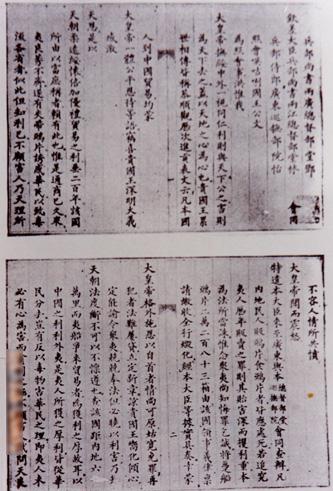
Lin Zexu (LinTse-hsu) writing to Britain's Queen Victoria
to Protest the Opium Trade, 1839
This selection is from Wallbank, et al, Civilizations Past And Present, 1992. Most scholars do not believe that the letter ever reached the Queen.
[Wallbank introduction] Lin Tse-hsu saw that the opium trade, which gave Europe such huge profits, undermined his country. He asked Queen Victoria to put a stop to the trade.
"After a long period of commercial intercourse, there appear among the crowd of barbarians both good persons and bad, unevenly. Consequently there are those who smuggle opium to seduce the Chinese people and so cause the spread of the poison to all provinces. Such persons who only care to profit themselves, and disregard their harm to others, are not tolerated by the laws of heaven and are unanimously hated by human beings. His Majesty the Emperor, upon hearing of this, is in a towering rage. He has especially sent me, his commissioner, to come to Kwangtung, and together with the governor-general and governor jointly to investigate and settle this matter.
"All those people in China who sell opium or smoke opium should receive the death penalty. If we trace the crime of those barbarians who through the years have been selling opium, then the deep harm they have wrought and the great profit they have usurped should fundamentally justify their execution according to law. We take into consideration, however, the fact that the various barbarians have still known how to repent their crimes and return to their allegiance to us by taking the 20,183 chests of opium from their storeships and petitioning us, through their consular officer [superintendent of trade], Elliot, to receive it. It has been entirely destroyed and this has been faithfully reported to the Throne in several memorials by this commissioner and his colleagues.
"Fortunately we have received a specially extended favor from is Majesty the Emperor, who considers that for those who voluntarily surrender there are still some circumstances to palliate their crime, and so for the time being he has magnanimously excused them from punishment. But as for those who again violate the opium prohibition, it is difficult for the law to pardon them repeatedly. Having established new regulations, we presume that the ruler of your honorable country, who takes delight in our culture and whose disposition is inclined towards us, must be able to instruct the various barbarians to observe the law with care. It is only necessary to explain to them the advantages and disadvantages and then they will know that the legal code of the Celestial Court must be absolutely obeyed with awe.
"We find that your country is sixty or seventy thousand li [three li equal one mile] from China. Yet there are barbarian ships that strive to come here for trade for the purpose of making a great profit. The wealth of China is used to profit the barbarians. That is to say, the great profit made by barbarians is all taken from the rightful share of China. By what right do they then in return use the poisonous drug to injure the Chinese people? Even though the barbarians may not necessarily intend to do us harm, yet in coveting profit to an extreme, they have no regard for injuring others. Let us ask, where is your conscience? I have heard that the smoking of opium is very strictly forbidden by your country; that is because the harm caused by opium is clearly understood. Since it is not permitted to do harm to your own country, then even less should you let it be passed on to the harm of other countries - how much less to China!"
Friday, February 16, 2007
Wednesday, February 14, 2007
anne frank's dad's letters to an american were uncovered, mainly communicating his desperate effort to get to america. in this age, when few write letters, what will be left for the coming generations to uncover? nothing. our civilization will become unreadable inaccessible hidden information, the bits on harddiscs, cds and servers. with the rise of the digital age, the intellectual side of us becomes more and more concealed. when we get buried by volcano ashes there will be nothing for the archeologists in the future to interpret, because the virtual world where all information is stored will crash more cleanly than the physical world. maybe that's why we don't find evidence for past advanced civilizations. maybe all of their intelligence eventually got into some kind of abstract storage which vanished with their creator, leaving no remains.
Tuesday, February 13, 2007
esherick also propose that the communist revolution in china shouldn't be looked at as a peasant revolution, or proletarian revolution, but a bourgeois revolution. the first thing that the communists did was land reform, which ensures that individual peasants own a share of land. this promoted private property. and they were highly supportive of market economy in the rural area. such action won them support from the peasants. it was later in the 50's when they started establishing communes and practised collectivism that they touched upon real communism, but such policies caused them to lose support from the peasants. it is a fresh angle certainly. i need to think about it...
i had a revelation today during esherick's lecture.
think about the late 19th century around the time of opium war. huge amount of products, mainly tea and also porcelain, was exported from china to britain. naturally huge amount of silver (actually mined in the new world) flowing into the middle kingdom. apparently, as much as 50% of the mexican silver that the europeans obtained ended up in china. to balance the trade, the british tried very very hard to pursuade the Qing emperors to open up ports so that they could sell the products of their industrial revolution, such as textile, knives and forks and clocks. but self sufficient as the Qing empire was in the nineteenth century, the chinese people wouldn't buy any, cos obviously they didn't need any. so the british smuggled in opium, a product that had a promoting demand, and, when challenged by the chinese prohibition of opium, waged a war. thus modern chinese history starts.
and then i thought, look at the trade. tea into britain and opium in to china. the former is a neuro-stimulant and the latter a neuro-depressant. it is no wonder why the former nation grew and the latter fell. how lousy a trader is britain!
think about the late 19th century around the time of opium war. huge amount of products, mainly tea and also porcelain, was exported from china to britain. naturally huge amount of silver (actually mined in the new world) flowing into the middle kingdom. apparently, as much as 50% of the mexican silver that the europeans obtained ended up in china. to balance the trade, the british tried very very hard to pursuade the Qing emperors to open up ports so that they could sell the products of their industrial revolution, such as textile, knives and forks and clocks. but self sufficient as the Qing empire was in the nineteenth century, the chinese people wouldn't buy any, cos obviously they didn't need any. so the british smuggled in opium, a product that had a promoting demand, and, when challenged by the chinese prohibition of opium, waged a war. thus modern chinese history starts.
and then i thought, look at the trade. tea into britain and opium in to china. the former is a neuro-stimulant and the latter a neuro-depressant. it is no wonder why the former nation grew and the latter fell. how lousy a trader is britain!
Monday, February 12, 2007
Looking at this, there's no reason i should move to the east coast for grad school.
according to National Georgraphic "Cities with More Single Men than Women: Los Angeles/Long Beach/Santa Ana urban area (Largest plurality: 40,000 more single men than women) Seattle Las Vegas Phoenix Houston
Cities with More Single Women than Men: New York/N.J./Conn. urban area (Largest plurality: 185,000 more single women than men) Washington Philadelphia Chicago Baltimore"
from 1010 wins
according to National Georgraphic "Cities with More Single Men than Women: Los Angeles/Long Beach/Santa Ana urban area (Largest plurality: 40,000 more single men than women) Seattle Las Vegas Phoenix Houston
Cities with More Single Women than Men: New York/N.J./Conn. urban area (Largest plurality: 185,000 more single women than men) Washington Philadelphia Chicago Baltimore"
from 1010 wins
Monday, February 05, 2007
the chinese seem to have retained the coherence of our identity largely through the preservation of the language and cultural system, specifically the confucian values. this is why the various foreign rulers of china have failed to strip the chinese of our chineseness, and instead have become sinified on various levels. the mongols, turks and other nomads came and went without causing much change in the chinese societal structure, while the manchus got assimilated into the chinese society themselves and are not to be distinguished from the general han population. i believe the reason why the chinese were able to do all these things was their wariness and on some level suspicion and hostility against the foreigners, which all resulted in a strong urge to maintain the cultural self. similar to the jewish identity that have been kept through the ages of banishment and insults. the more a group is against its enemies, the more the groups sticks together.
the embrace of foreigners by the chinese in recent years is going to change the situation. the new attitude is formed mainly due to the advances in the west and the contrasting backwardness of china's own economy. this is a reality learnt through harsh defeats and treaties. the people have come to wordship the affluent west and grown tired of the improverished motherland. this change in attitude breakes the cultural great wall and is going to bring an end to the lifeline of the chinese, its culture. the ernest study and proper use of the chinese language is already on a decline. traditional art forms struggles to keep alive and are failing more and more to do so. people's focus is more and more on the economical development and expansion, much like the west. the study of western languages with its obvious profitability rises in priority. and with the study of western culture, western values come to infiltrate the society with much ease, replacing the traditional values. maybe soon the word chinese will be merely a political term, describing things and people found within the current chinese border. much like egypt, whose content has nothing much to do with the original connotations of the name.
it's not that i'm emotionally attached to confucian values. such old principles are very very outdated and impedes the development of a healthy modern society. i just want to point out, the changed that occured in the last century seems to be the first time that the chinese are systematically abandoning the values that have held the country together for two thousand years and more. china and the chinese race seem to be on the verge of unprecedented and irreversible change. oh well, old things die and new things come. it's no big deal. and who knows. maybe in the process of developing a modern globe, all cultures would lose its original contents as a result of mixing sooner or later. my attitude on the issue of chinese culture is like that on any other thing. while i'm excited to see what's to come, such as all the modernity, freedom and fantastic possibilities, i can't help but feel a little pity for the old dying thing. because the interesting and beautiful half and the dull and ugly half necessarily die together.
the embrace of foreigners by the chinese in recent years is going to change the situation. the new attitude is formed mainly due to the advances in the west and the contrasting backwardness of china's own economy. this is a reality learnt through harsh defeats and treaties. the people have come to wordship the affluent west and grown tired of the improverished motherland. this change in attitude breakes the cultural great wall and is going to bring an end to the lifeline of the chinese, its culture. the ernest study and proper use of the chinese language is already on a decline. traditional art forms struggles to keep alive and are failing more and more to do so. people's focus is more and more on the economical development and expansion, much like the west. the study of western languages with its obvious profitability rises in priority. and with the study of western culture, western values come to infiltrate the society with much ease, replacing the traditional values. maybe soon the word chinese will be merely a political term, describing things and people found within the current chinese border. much like egypt, whose content has nothing much to do with the original connotations of the name.
it's not that i'm emotionally attached to confucian values. such old principles are very very outdated and impedes the development of a healthy modern society. i just want to point out, the changed that occured in the last century seems to be the first time that the chinese are systematically abandoning the values that have held the country together for two thousand years and more. china and the chinese race seem to be on the verge of unprecedented and irreversible change. oh well, old things die and new things come. it's no big deal. and who knows. maybe in the process of developing a modern globe, all cultures would lose its original contents as a result of mixing sooner or later. my attitude on the issue of chinese culture is like that on any other thing. while i'm excited to see what's to come, such as all the modernity, freedom and fantastic possibilities, i can't help but feel a little pity for the old dying thing. because the interesting and beautiful half and the dull and ugly half necessarily die together.
Tuesday, January 23, 2007

Saturday, January 13, 2007
finally saw the first emperor on the met live hd broadcast. my overall feeling is that it is a rather risky project for tan dun. while fusion is more and more becoming the trend in the arts, he does it too deliberately. he seemed to be trying to please too many people, throwing all available musical elements in there, be it chinese, romantic, or contemporary... while there was no particularly memorable meoldy line for it to really sound chinese or puccinian, it was too concrete to be minimalistic. somewhat neither here nor there. and it was unnecessarily long. could be easily compacted into 2-2 1/2 hours long. it dragged on and on, losing much of the audience's attention and in the end weakening the climax's strength, although i did like the ending very much.
visually it was satisfactory. the set was very nice. domingo was very good. yueyang could've been prettier. the least they coul do was to give everybody chinese dance training to get the mannerism right. not quite there. costume was nice. dance was good.
ha jin sucked. the libretto was a joke. they should've gotten gao xingjian to write it in chinese. lol. or get an english speaker to write it in english.
need to go. more to come
visually it was satisfactory. the set was very nice. domingo was very good. yueyang could've been prettier. the least they coul do was to give everybody chinese dance training to get the mannerism right. not quite there. costume was nice. dance was good.
ha jin sucked. the libretto was a joke. they should've gotten gao xingjian to write it in chinese. lol. or get an english speaker to write it in english.
need to go. more to come
Friday, January 12, 2007
Tuesday, November 28, 2006
Monday, November 27, 2006
Helsinki Complaints Choir
dude. this is funniest thing i've seen in a while.. lol. and the most true to the lyrics singing i have ever seen haha... they really look like they mean it. of course they do.
also from the composers' website:
The First Complaints Choir of Birmingham became a surprise success and soon after we received many requests from people who hoped for a complaints choir in their hometown as well. They expressed (almost with a certain pride) that in their particular town people are especially talented complainers: either by quantity (Belgrade), existentialism (St. Petersburg) or sophistication (Buenos Aires).
enjoy!
Sunday, November 19, 2006
Women of the world, raise your right hand.
Ad campaign by A Diamond Is Forever has been around for a while. It says:
Your left hand says 'we.' Your right hand says 'me.' Your left hand rocks the cradle. Your right hand rules the world. Women of the world, raise your right hand. A Diamond is Forever. The New Diamond Right Hand Ring. Romantic, Modern Vintage, Floral and Contemporary Styles at ADIAMONDISFOREVER.COM
How clever.
Far from being the rarest stones in nature and certainly not able to last forever (try burning that stone), diamonds are just another not-so-apt embodiment of some constructed ideology. The invention of engagement ring in the early twentieth century was a huge commercial success. Now that feminism is in, the diamond giants have to move along too. Hence the right hand ring campaign, and finally the corporations have sussessfully captured 90% of the world's affluent women. It is ironic that in this case feminism is being rubbed into the one of the most prominent symbols of capitalist exploitations. Diamond mining and cutting have often been associated with slavery for good reasons. A feminist would be an idiot to buy that ring from adiamondisforever to MAKE A STATEMENT. What kind of statement would come out of that?
All said, I would not hesitate to raise my right hand. But just not with a stone from de Beers or adiamondisforever. For decoration, my fingers would at the most have on them a blinding cubic zirconia from Icing for 5 bucks.
Your left hand says 'we.' Your right hand says 'me.' Your left hand rocks the cradle. Your right hand rules the world. Women of the world, raise your right hand. A Diamond is Forever. The New Diamond Right Hand Ring. Romantic, Modern Vintage, Floral and Contemporary Styles at ADIAMONDISFOREVER.COM
How clever.
Far from being the rarest stones in nature and certainly not able to last forever (try burning that stone), diamonds are just another not-so-apt embodiment of some constructed ideology. The invention of engagement ring in the early twentieth century was a huge commercial success. Now that feminism is in, the diamond giants have to move along too. Hence the right hand ring campaign, and finally the corporations have sussessfully captured 90% of the world's affluent women. It is ironic that in this case feminism is being rubbed into the one of the most prominent symbols of capitalist exploitations. Diamond mining and cutting have often been associated with slavery for good reasons. A feminist would be an idiot to buy that ring from adiamondisforever to MAKE A STATEMENT. What kind of statement would come out of that?
All said, I would not hesitate to raise my right hand. But just not with a stone from de Beers or adiamondisforever. For decoration, my fingers would at the most have on them a blinding cubic zirconia from Icing for 5 bucks.
Friday, October 27, 2006
Saturday, October 21, 2006
Thursday, October 19, 2006
monogamy is evolutionarily advantageous
formation of monogamy ensures diversity in the human gene pool.
my reasoning is as follows.
a human male in the case of reproduction is in the position of choice because females are limited by pregnancy. given the freedom, a human male will spread his sperms as far as possible, which is the seen today as the animcal instinct, and have multiple children concurrently. females however will have the burden of waiting for one child to come before having another. without monogamy, only the strongest and smartest guys get laid. soon the human gene pool will be filled with the traits of a small fraction of males. therefore the species would be less adaptive towards the changing environment.
when monogamy is enforced through cultural and social structures, however, a great many more guys can get laid due to removal of monopoly.
this also explains another problem that i have been thinking about for a long time. that is, why humans have evolved to wear clothes. by covering up the private parts, humans are less aroused sesually when they meet the opposite sex. on one hand, this may shift our attention to more "constructive" activities such as the development of civilization, which will benefit the survival of the species. (although i do not see how we could have known this before we created civilization). on the other hand, this could also be a by-product of the desire to keep monogamy, so that each person is only aroused by his or her partners in designated situations. and therefore benefit the species.
there might be a nother reason for clothing. maybe it acts like a dam, so that a human only conducts sexual acts when they meet the most desirable partner. this is because?
my reasoning is as follows.
a human male in the case of reproduction is in the position of choice because females are limited by pregnancy. given the freedom, a human male will spread his sperms as far as possible, which is the seen today as the animcal instinct, and have multiple children concurrently. females however will have the burden of waiting for one child to come before having another. without monogamy, only the strongest and smartest guys get laid. soon the human gene pool will be filled with the traits of a small fraction of males. therefore the species would be less adaptive towards the changing environment.
when monogamy is enforced through cultural and social structures, however, a great many more guys can get laid due to removal of monopoly.
this also explains another problem that i have been thinking about for a long time. that is, why humans have evolved to wear clothes. by covering up the private parts, humans are less aroused sesually when they meet the opposite sex. on one hand, this may shift our attention to more "constructive" activities such as the development of civilization, which will benefit the survival of the species. (although i do not see how we could have known this before we created civilization). on the other hand, this could also be a by-product of the desire to keep monogamy, so that each person is only aroused by his or her partners in designated situations. and therefore benefit the species.
there might be a nother reason for clothing. maybe it acts like a dam, so that a human only conducts sexual acts when they meet the most desirable partner. this is because?
Wednesday, October 18, 2006
it's good to get up in the morning. (although i didn't really sleep much.) after my vector calculus midterm, i am sitting at sierra summit savoiuring a good omlette with the company georges brassens' adorable songs. and i'm looking at the pretty picture i took yesterday. and i think to myself, life can't be better :)

Sunday, October 15, 2006
squared circles

touring bike
Originally uploaded by LeoL30.
seeing people's fascination about squared circular object is fascinating.
Thursday, October 12, 2006
Thursday, October 05, 2006
Wednesday, October 04, 2006
Monday, October 02, 2006
kongerei.
have you ever heard any overtone singing? have you heard tuvan and mongolian singings, like singing into the mountains and the grassland? i have only heard overtone singing once and have only heard mongolian long songs, but not throat singing. it's overwhelming.
kronos quartet got the throat singers from the land of Tuva to sing this kongerei for them, and for us. the ancient and sorrowful yearning therefore rings in my headphones. the strings keep a stead pulse, with the cello crying like the horse head fiddle alongside. immediately visible to me is a picture of vast plateau, on which a shepherd and his herd move steadily. he sings a low fundamental tone, heavy and coarse. suddenly there's this other sound. a whistle, a bird song, or a flute, floating indeterminably at the top. and then his sound becomes part of nature. and he moves on, a person without home. a people without home. a lonely people in the midst of the vastness. singing, and moving.
have you ever heard any overtone singing? have you heard tuvan and mongolian singings, like singing into the mountains and the grassland? i have only heard overtone singing once and have only heard mongolian long songs, but not throat singing. it's overwhelming.
kronos quartet got the throat singers from the land of Tuva to sing this kongerei for them, and for us. the ancient and sorrowful yearning therefore rings in my headphones. the strings keep a stead pulse, with the cello crying like the horse head fiddle alongside. immediately visible to me is a picture of vast plateau, on which a shepherd and his herd move steadily. he sings a low fundamental tone, heavy and coarse. suddenly there's this other sound. a whistle, a bird song, or a flute, floating indeterminably at the top. and then his sound becomes part of nature. and he moves on, a person without home. a people without home. a lonely people in the midst of the vastness. singing, and moving.
Sunday, October 01, 2006
maybe great people shouldn't get married. maybe each great man should marry a housewife and each great woman should get herself a househusband. or, a great couple should just get a maid. damn.
»Clara has composed a series of small pieces, which show a musical and tender ingenuity such as she has never attained before. But to have children, and a husband who is always living in the realm of imagination, does not go together with composing. She cannot work at it regularly, and I am often disturbed (Oh Really?)to think how many profound ideas are lost because she cannot work them out.«
—Robert Schumann in the joint diary of Robert and Clara Schumann.
»Composing gives me great pleasure...there is nothing that surpasses the joy of creation, if only because through it one wins hours of self-forgetfulness, when one lives in a world of sound.«
—Clara herself on composing.
»I once believed that I possessed creative talent, but I have given up this idea; a woman must not desire to compose — there has never yet been one able to do it. Should I expect to be the one?«
—Clara Schumann at 20
-wikipedia
»Clara has composed a series of small pieces, which show a musical and tender ingenuity such as she has never attained before. But to have children, and a husband who is always living in the realm of imagination, does not go together with composing. She cannot work at it regularly, and I am often disturbed (Oh Really?)to think how many profound ideas are lost because she cannot work them out.«
—Robert Schumann in the joint diary of Robert and Clara Schumann.
»Composing gives me great pleasure...there is nothing that surpasses the joy of creation, if only because through it one wins hours of self-forgetfulness, when one lives in a world of sound.«
—Clara herself on composing.
»I once believed that I possessed creative talent, but I have given up this idea; a woman must not desire to compose — there has never yet been one able to do it. Should I expect to be the one?«
—Clara Schumann at 20
-wikipedia
Saturday, September 30, 2006
revisiting saint-saens
don't you ever wonder what kind of person he is? he must have been capable of such tender feelings. or how could he have written something like the swan? no matter how overplayed this piece is, it never fails to rouse the deepest awe in me.and he must have been a very interesting person, judging from the colourful aquarium. i want to know him in person! (sorry about sounding so cheezy)
there you have it, the difference between the two different kinds of creations, the sciences and the arts. the arts are so exposing. you have so much of you in it. (like wilde discussed). you only need to look at or listen to a piece to know the persona of its creator. it's like all the feelings channeled to you through broadband connection. but science. you can read so many papers by the researcher and not know who he's like. he would be this entity in your mind, without a face, without a character. the only thing you get to know after all is if he is clever. so different.
there you have it, the difference between the two different kinds of creations, the sciences and the arts. the arts are so exposing. you have so much of you in it. (like wilde discussed). you only need to look at or listen to a piece to know the persona of its creator. it's like all the feelings channeled to you through broadband connection. but science. you can read so many papers by the researcher and not know who he's like. he would be this entity in your mind, without a face, without a character. the only thing you get to know after all is if he is clever. so different.
have to say this before i stop
i watched tokyo trial yesterday with my friends. we also discussed war in general as we watched the movie. history is written by the winners. trials are carried out by the winners. humans being humans, i guess it is hard to judge anything on purely moral grounds. maybe there need not be a moral theory. maybe the world can only be run on economic principles and their extensions - political theories.
anyways, i wiki-ed the trial and found the following:
Radhabinod Pal, the Indian justice at the IMTFE, argued in his dissenting opinion that Japan was innocent. He wrote, "If Japan is judged, the Allies should also be judged equally." However, his opinion was not shared by the majority of the justices at Tokyo.
-wikipedia
i wouldn't say that japan was innocent, but the quote is good food for thought, isn't it.
i watched tokyo trial yesterday with my friends. we also discussed war in general as we watched the movie. history is written by the winners. trials are carried out by the winners. humans being humans, i guess it is hard to judge anything on purely moral grounds. maybe there need not be a moral theory. maybe the world can only be run on economic principles and their extensions - political theories.
anyways, i wiki-ed the trial and found the following:
Radhabinod Pal, the Indian justice at the IMTFE, argued in his dissenting opinion that Japan was innocent. He wrote, "If Japan is judged, the Allies should also be judged equally." However, his opinion was not shared by the majority of the justices at Tokyo.
-wikipedia
i wouldn't say that japan was innocent, but the quote is good food for thought, isn't it.
Friday, September 29, 2006
seems that it will be extremely difficult to maintain a normal lifestyle with the five classes and one thesis i'm taking upon myself, therefore, this blog is tentatively closed down until further notice.
also, it's hard to maintain any level of consciousness with my regular diet, therefore, a 200ml dose of 52µM caffeine has been added to my recommended daily value.
also, it's hard to maintain any level of consciousness with my regular diet, therefore, a 200ml dose of 52µM caffeine has been added to my recommended daily value.
Thursday, September 28, 2006
so do you also have the feeling that many people get cynical, jaded, tired, no longer excited about science after they have done a lot of it. some old phd students and postdocs from the many labs i've been in seem to be so. or maybe they are just stressed/exhausted at the point they make comments with such cynicism.
i'm raising this not because i recently discovered this cynicism and lethargy, but because of my discovery of enthusiasm in many scientists around me. things like science is boring but the findings are glorious and i'll be able to take the boredom are easier said than done. and only after you work and fail and struggle do you come to appreciate the enthusiasm that has somehow survived.
i'm raising this not because i recently discovered this cynicism and lethargy, but because of my discovery of enthusiasm in many scientists around me. things like science is boring but the findings are glorious and i'll be able to take the boredom are easier said than done. and only after you work and fail and struggle do you come to appreciate the enthusiasm that has somehow survived.
i passed out at 8pm after i came back from school. been a long day. when i woke up i could hardly figure out the time-space i was in. with the many projects on hand, i had to get up and resume work. but somehow i wound up at my old blog on livejournal. i was entirely surprised at how lucid and flowy my writing was. it seemed to be a more open-minded, inquisitive and less prejudiced me, with a greater and better and less cynical sense of humour, and many more thoughts. what has university education done to me? lol
but my lonertrip entries. i never failed to be moved when i read them again. and i'm so glad that i wrote all that experience down.
but my lonertrip entries. i never failed to be moved when i read them again. and i'm so glad that i wrote all that experience down.
Wednesday, September 27, 2006
ctrl+tab
after the final and complete move from safari to firefox, i had to get used to many things. (the move took very long cos safari was really one good browser. but it was inevitable because safari started crashing like nobody's business some months ago.) i was googling for the shortcut keys for swapping between tabs in firefox, and encoutered this chap asking the same question in the firefox forum. some other guy replied that ctrl+tab will do and i got the answer i wanted. thing is, the guy with the question replied again to say that he knew about ctrl+tab but he wanted a one key access like F2 or F3. nobody replied further.
i don't quite agree with that guy. i'd rather use the keyboard than the mouse because i think the keyboard gets things done faster. i think the whole point of using keyboard access is to make things faster. and the whole point of most people using modifier keys such as shift ctrl alt fn and command is that we keep using them and their locations are like second nature to us. i might have to look to find the number 5, but i don't in the case of modifier keys. there also enough of them that the combination between these keys and a limited number of other keys could indeed excecute many many commands. therefore, even if it involves 2 keys instead of one, it's still faster.
i don't quite agree with that guy. i'd rather use the keyboard than the mouse because i think the keyboard gets things done faster. i think the whole point of using keyboard access is to make things faster. and the whole point of most people using modifier keys such as shift ctrl alt fn and command is that we keep using them and their locations are like second nature to us. i might have to look to find the number 5, but i don't in the case of modifier keys. there also enough of them that the combination between these keys and a limited number of other keys could indeed excecute many many commands. therefore, even if it involves 2 keys instead of one, it's still faster.
Tuesday, September 26, 2006
How do you it's too much
after a full plate of indian food, two sodas and 4 talks later, i realised that the neurodinner is not quite the after work retreat i thought i was going into. maybe four talks in one go are a lot, even if they were straight from one lab. by the end of the whole thing i pretty much forgot everything except one or two problems i had with the data. and five minutes later, i could hardly remember them. there were about 100 questions raised, some were brilliant, but soon i found myself forgetting not only who asked the brilliant questions, but what they were. good for me. when you experience temporary brain death after a session like this, you know it's enough. it feels exactly like the day i took three bio finals.
some take home points though, out of the only residue memory i had of the talks.
1. everything really has to make biological sense. one of the speakers proposed options that were not biologically logical, and kept emphasising that those were merely "possibilities", or "extreme options". she reminded me of this quote i saw earlier today: "It is undesirable to believe a proposition when there is no ground whatsoever for supposing it is true". I thought the quote was duh when i read it in the morning, but now i see that there might be a point to it.
2. when you try to show a thing, you might want to use the most appropriate tool. for example, if a categorization of a population of cells is to be done based on genetic profile, an in situ might really be a better option than trying to record from them under different biochemical environments. so a colleague said, sometimes you are so in love with the technique you do that you forget the problems you're addressing. that, clearly should not be the case.
some take home points though, out of the only residue memory i had of the talks.
1. everything really has to make biological sense. one of the speakers proposed options that were not biologically logical, and kept emphasising that those were merely "possibilities", or "extreme options". she reminded me of this quote i saw earlier today: "It is undesirable to believe a proposition when there is no ground whatsoever for supposing it is true". I thought the quote was duh when i read it in the morning, but now i see that there might be a point to it.
2. when you try to show a thing, you might want to use the most appropriate tool. for example, if a categorization of a population of cells is to be done based on genetic profile, an in situ might really be a better option than trying to record from them under different biochemical environments. so a colleague said, sometimes you are so in love with the technique you do that you forget the problems you're addressing. that, clearly should not be the case.
quote of the day:
If the human mind was simple enough to understand, we'd be too simple to understand it.
- Emerson Pugh
pugh assumes that the process of "understanding" definitely implies that the entity to understand is of higher order than the entity to be understood. therefore. isn't it also true that no matter how simple/complex the human brain is, no matter what it is, it can never understand itself?
If the human mind was simple enough to understand, we'd be too simple to understand it.
- Emerson Pugh
pugh assumes that the process of "understanding" definitely implies that the entity to understand is of higher order than the entity to be understood. therefore. isn't it also true that no matter how simple/complex the human brain is, no matter what it is, it can never understand itself?
Monday, September 25, 2006
during the precious hour break this morning i quickly went to sierra and ordered myself a delicious steamy plate of breakfast special. as i started simulating the orchestration of gustatory stimuli by the mixture of hashbrown and ketchup my taste receptors will receive soon, i discovered that the ketchup tub was empty. that is just the greatest dismay that can ever happen to me.
by the time the newbie in sierra replaced the ketchup bag i was halfway through the plate, cos as much as i love ketchup, i dislike cold food. as a result, i had half of my food without ketchup and the other half cold.
or, would you say that, at least i had half of my food hot, and the other half with ketchup?
by the time the newbie in sierra replaced the ketchup bag i was halfway through the plate, cos as much as i love ketchup, i dislike cold food. as a result, i had half of my food without ketchup and the other half cold.
or, would you say that, at least i had half of my food hot, and the other half with ketchup?
Friday, September 22, 2006
Thursday, September 21, 2006
after taking the performance making class some observations have dawned on me (me being a slightly post-layman pre-amateur music lover). the modern music history, especially the emergence of "new music" is largely trying to liberate music from it's present "elitist" form, i.e. granting the access to a body of esoteric means and materials to only a handful of trained professional/affluent amateurs. new concepts have been introduced, new instruments and new ways to play them are added to the repertoire. housewives who make sounds on household itmes and toys are now considered serious musical groups. there are objections to the trend, of course. but the objection comes surprisingly, from laymen (of course, or extremely conservative musicians) more often than from a well-informed and trained musician. the concept of serious music as being elitist by definition is so deeply rooted in a layman that its abolition seems ridiculous. more than once have i heard such statements "this can't be considered music" or "it's like a license to doing anything on earth by calling the music modern" from laymen in reaction to a contempory piece. isn't it a little ironic when the laymen who would potentially benefit from the de-elitization of music object the most readily to this process? same goes to modern art, i have to add. the rate at which an art piece is dismissed without being scrutinized upon is astonishing.
maybe we have been tuned to a certain form of audio/visual stimuli, and it'll take us much longer than a few hundred years to start appreciating something new? maybe that just proves that the artists are always on the frontier of the society. i wonder.
maybe we have been tuned to a certain form of audio/visual stimuli, and it'll take us much longer than a few hundred years to start appreciating something new? maybe that just proves that the artists are always on the frontier of the society. i wonder.
Monday, September 18, 2006
Monday, September 11, 2006
Thursday, September 07, 2006
ugh! love the internet.
i chanced upon a webpage with an article Shu Ting wrote about Gu Cheng. Both are comtemporary Chinese poets. The former is one of my favorite poets. The latter killed his wife and committed suicide afterwards. On that page, there was a scanned in newspaper cutting with pictures of Gu Cheng and his response in an interview. He said.
"Having your poetry read is like being a fish displayed frozen on a fishmonger's slab. People say it tastes good but no one would like to swim in the sea with it." (how true...)
i haven't read his stuff for ages, but one of his lines would always give me the shiver whenever i read it.
A Generation (Translation by Joseph R. Allen)
Even with these dark eyes, a gift of the dark night
I go to seek the shining light
一代人 (顾城)
黑夜給了我黑色的眼睛
我卻用它尋找光明
in this case i wouldn't translate the verse with "Even". I feel that the original poem has a sense of irony in it, which is lost in the translation(although it rhymes). and i hate the "shining" part. too much unnecessary ornamentations. make the poem lose its transparency. I think the translator would be better off just literally translating it. like,
the dark night gave me these dark eyes,
but with them, i go to seek the light.
i chanced upon a webpage with an article Shu Ting wrote about Gu Cheng. Both are comtemporary Chinese poets. The former is one of my favorite poets. The latter killed his wife and committed suicide afterwards. On that page, there was a scanned in newspaper cutting with pictures of Gu Cheng and his response in an interview. He said.
"Having your poetry read is like being a fish displayed frozen on a fishmonger's slab. People say it tastes good but no one would like to swim in the sea with it." (how true...)
i haven't read his stuff for ages, but one of his lines would always give me the shiver whenever i read it.
A Generation (Translation by Joseph R. Allen)
Even with these dark eyes, a gift of the dark night
I go to seek the shining light
一代人 (顾城)
黑夜給了我黑色的眼睛
我卻用它尋找光明
in this case i wouldn't translate the verse with "Even". I feel that the original poem has a sense of irony in it, which is lost in the translation(although it rhymes). and i hate the "shining" part. too much unnecessary ornamentations. make the poem lose its transparency. I think the translator would be better off just literally translating it. like,
the dark night gave me these dark eyes,
but with them, i go to seek the light.
Thursday, August 31, 2006
mozart's piano quartet in G is quite nice. especially the first movement. i've never been particularly affected by mozart's music, for the same reason why i thought bach was boring. both are geniuses, but there are simply "too many notes" (from movie amadeus). both feel like a kind of show-off, and neither one stirs my emotions very much. such music i would categorise into the group which cannot be appreciated until you take the score and read and enjoy all the craftiness in the structure, and is a delight to perform. but after all is music a craft or an art? the function of art... what's the form for if that art cannot stir?
but the quartet in G is actually quite angry in the first movement, (and therefore sounds like beethoven a little bit). mozart's music is too pretty, except for some of his later works. i somehow feel that this clever man wasn't alive long enough to live life proper. his life ended shortly after the hedonistic youth, which he spent crafting pretty pieces, before he could experience any of the major emotions that he potentially could have exprience had he grown to be 40, 50 or 60. minimal bitterness in his composition. no frustration. not much anguish. nothing too profound. if he'd been through what beethoven did, i'm sure he could have written something brilliant. and it's indeed a pity. nevertheless, he's a genius, and above all, an interesting person, in the world of two categories of people. ah, and all interesting people are hated, all the time.
but the quartet in G is actually quite angry in the first movement, (and therefore sounds like beethoven a little bit). mozart's music is too pretty, except for some of his later works. i somehow feel that this clever man wasn't alive long enough to live life proper. his life ended shortly after the hedonistic youth, which he spent crafting pretty pieces, before he could experience any of the major emotions that he potentially could have exprience had he grown to be 40, 50 or 60. minimal bitterness in his composition. no frustration. not much anguish. nothing too profound. if he'd been through what beethoven did, i'm sure he could have written something brilliant. and it's indeed a pity. nevertheless, he's a genius, and above all, an interesting person, in the world of two categories of people. ah, and all interesting people are hated, all the time.
the first time i listened to steve reich, i thought what a genius. the more i listen, the more i feel that he's just a minimalist poser. like everyone else. Innovation can only be done once?
but dawn upshaw singing yanov-yanovsky's lacrymosa is just right. just right. so hauntingly beautiful. my hair kept standing. i would really like to see the score, cos i'm sure there's special instruction for the way the voice slides. upshaw slides on purpose for most of her performances and gets away with it with her celebrity license (and i do like the way she slides.) this piece, however, is slightly different in that she has virtually no steps between any two notes. all is sliding. (ok, maybe except for 2 places.) it's creepy.
fyi, the classical italian bel canto does not allow sliding of voice from note to note, although the central feature of bel canto singing is legato, meaning joining the notes. in fact, legato singing without much sliding is a very difficult technique. i see this a very unnatural phenomenon as most cultures have sliding in their singing (the so called "vocal"-ness in singing and playing). you see, singing without sliding is like mimicing an instrument because most western instruments cannot slide (except for strings). while the western europeans spend that extra effort to sing like an instrument, other cultures try very hard to play like a singing voice. the sliding lines in many chinese, indian, middle eastern and east european instruments, show such tendencies. i used to be criticised very frequently for sliding into and out of my notes, which i then concluded to root in my exposure to chinese music, in which virtually every instrument, especially voice, slides in and out of almost everything. i like it better that way, it gives the music much more room for subtle manipulation. don't you agree. it's beautiful when you have all that pitches in between.
but dawn upshaw singing yanov-yanovsky's lacrymosa is just right. just right. so hauntingly beautiful. my hair kept standing. i would really like to see the score, cos i'm sure there's special instruction for the way the voice slides. upshaw slides on purpose for most of her performances and gets away with it with her celebrity license (and i do like the way she slides.) this piece, however, is slightly different in that she has virtually no steps between any two notes. all is sliding. (ok, maybe except for 2 places.) it's creepy.
fyi, the classical italian bel canto does not allow sliding of voice from note to note, although the central feature of bel canto singing is legato, meaning joining the notes. in fact, legato singing without much sliding is a very difficult technique. i see this a very unnatural phenomenon as most cultures have sliding in their singing (the so called "vocal"-ness in singing and playing). you see, singing without sliding is like mimicing an instrument because most western instruments cannot slide (except for strings). while the western europeans spend that extra effort to sing like an instrument, other cultures try very hard to play like a singing voice. the sliding lines in many chinese, indian, middle eastern and east european instruments, show such tendencies. i used to be criticised very frequently for sliding into and out of my notes, which i then concluded to root in my exposure to chinese music, in which virtually every instrument, especially voice, slides in and out of almost everything. i like it better that way, it gives the music much more room for subtle manipulation. don't you agree. it's beautiful when you have all that pitches in between.
Something i didn't know before, the part about how camera works. on a related note, i just got a new email address sangyu at flyeye dot ucsd dot edu. feel free to utilize my lab server space.
had to get the tv series crave out of my system way before sch starts or i'd just die. so i watched tokyo love story again. i thought maybe i was sillier 10 years ago, but no, i wasn't. the show is still good. you who have watched it know what i'm talking about.
but for sex and the city. the more i watch the more i don't get its point. it was supposed to be suggesting a new lifestyle for women, but the statement gets lost along the progress of the 6 seasons. in the end everybody was happily married or at least settled down for a better life to start. miranda and samantha might have avoided being a cliche like carrie(with big, ugh) or charlotte(with both men, ugh!), but they too were pressurised by either their biological clock or whatever that drove them into a settle relationship. in the end you get the feeling that such stress from life is inevitable and the only way women can find a better life is to succumb to it and conform. no more cynicism, of course, and sarcasm.
and so much for feminism.
had to get the tv series crave out of my system way before sch starts or i'd just die. so i watched tokyo love story again. i thought maybe i was sillier 10 years ago, but no, i wasn't. the show is still good. you who have watched it know what i'm talking about.
but for sex and the city. the more i watch the more i don't get its point. it was supposed to be suggesting a new lifestyle for women, but the statement gets lost along the progress of the 6 seasons. in the end everybody was happily married or at least settled down for a better life to start. miranda and samantha might have avoided being a cliche like carrie(with big, ugh) or charlotte(with both men, ugh!), but they too were pressurised by either their biological clock or whatever that drove them into a settle relationship. in the end you get the feeling that such stress from life is inevitable and the only way women can find a better life is to succumb to it and conform. no more cynicism, of course, and sarcasm.
and so much for feminism.
Wednesday, August 23, 2006
Maths 'Nobel' prize declined by Russian recluse
So Perelman declined the Fields, but why wouldn't Nature just call it the Fields? considering the reader group of this science journal, is nature afraid that the readers won't be able to make out the significance of this piece of news had they put the title "Fields medal declined by Russian recluse"? what's wrong with them.
and leave the russian recluse alone.
and leave the russian recluse alone.
Monday, August 21, 2006
Friday, August 18, 2006
after finishing running a gel at 930 and dragging my exhausted self home, i savoured an excellent pack of instant noodles. now i'm watching family guy on the computer, while snacking my friday night away on a horrendous looking but delicious white flesh nectarine, juicy californian raisins and a glass of instant Tang mango drink. oh, and wondering why i don't have a boyfriend.
Wednesday, August 16, 2006
Tuesday, August 15, 2006
Monday, August 14, 2006
send-offs
we are familiar with parting scenes in poems, stories, movies and all that. the depiction of a send-off is of course flooded with the all-absorbing emotions, as if that is the only thing occupying the minds of the persons being sent off and the persons sending off.
in reality, when kk stood in the LA airport beside us, flipping through the stuff in his waist pouch- passport, i20, airtickets and so on , -careful and focused, i realized there was little room for sentimental thoughts. whether it is a feature of modern life, or of real life itself, sending-offs are very much less romanticised than what we know them as. endless things to pack and time constraints on packing bring tremendous stress to the traveller. therefore lack of sleep. therefore more stress due to fear of missing anything important to traveling. travel has become such a hassel, with the heightened security checks in response to more terrorist attacks. those who are sending the traveller off also become nervous, and spend most of the time worrying about reminding the traveller about things to bring, about catching that flight, or just worrying. packing, driving, send-off lunch, send-off dinner, getting to the airport, queuing to check in that luggage, queuing to swap ticket for pass, queuing for security check. by the time everything is done, it's already one hour from boarding. so everyone sits down, heaving a sigh of relief. and then silence and occasional jokes to break the silence. and a brief good-bye. and off he or she goes. at this moment yesterday i was thinking maybe after all, it was better to have that hassle than not to have it. or the combination of heavy hearts and the long hours might have killed us all.
in reality, when kk stood in the LA airport beside us, flipping through the stuff in his waist pouch- passport, i20, airtickets and so on , -careful and focused, i realized there was little room for sentimental thoughts. whether it is a feature of modern life, or of real life itself, sending-offs are very much less romanticised than what we know them as. endless things to pack and time constraints on packing bring tremendous stress to the traveller. therefore lack of sleep. therefore more stress due to fear of missing anything important to traveling. travel has become such a hassel, with the heightened security checks in response to more terrorist attacks. those who are sending the traveller off also become nervous, and spend most of the time worrying about reminding the traveller about things to bring, about catching that flight, or just worrying. packing, driving, send-off lunch, send-off dinner, getting to the airport, queuing to check in that luggage, queuing to swap ticket for pass, queuing for security check. by the time everything is done, it's already one hour from boarding. so everyone sits down, heaving a sigh of relief. and then silence and occasional jokes to break the silence. and a brief good-bye. and off he or she goes. at this moment yesterday i was thinking maybe after all, it was better to have that hassle than not to have it. or the combination of heavy hearts and the long hours might have killed us all.
Sunday, August 13, 2006
Minty Acquisition

Before we sent our dear friend kk off the gang lunched at farmer's market in LA, and i chanced upon this beautifully designed tin of mints in a french store called Monsieur Marcel. Apparently it is part of a limited edition artist's series. I loved how green and transparent it looked, and the fairy tale like abstraction. The mints are fine. When am i going to stop buying candies for the tins?
Friday, August 11, 2006
Sunday, August 06, 2006
Ota Bengo
New York Times featured a photo story of Ota Bengo, the Congolese pygmy that was once exhibited with an orangutan at the Bronx Zoo. It is shocking how blatant the scientific racists were merely 100 years ago. More information on him at wikipedia.
Saturday, August 05, 2006
There he stood in the parlour of the poky little house where she had taken him, waiting for her, while she went upstairs a moment to see a woman. He heard her quick step above; heard her voice cheerful, then low; looked at the mats, tea-caddies, glass shades;waited quite impatiently; looked forward eagerly to the walk home; determined to carry her bag; then heard her come out; shut a door; say they must keep the windows open and the doors shut, ask at the house for anything they wanted (she must be talking to a child) when, suddenly, in she came, stood for a moment silent (as if she had been pretending up there, and for a moment let herself be now), stood quite motionless for a moment against a picture of Queen Victoria wearing the blue ribbon of the Garter; when all at once she realised that it was this: it was this: -- she was the most beautiful person he had ever seen.
With stars in her eyes and veils in her hair, with cyclamen and wild violets -- what nonsense what he thinking: She was fifty at least; she had eight children. Stepping through fields of flowers and taking to her breast buds that had broken and lambs that had fallen; with the stars in her eyes and the wind in her hair -- He took her bag.
"Good-bye, Elsie," she said, and they walked up the street, she holding her parasol erect and walking as if she expected to meet some one around the corner, while for the first time in his life Charles Tansley felt an extraordinary pride; a man digging in a drain stopped digging and looked at her, let his arm fall down and looked at her; for the first time in his life Charles Tansley felt an extraordinary pride; felt the wind and the cyclamen and the violets for he was walking with a beautiful woman. He had hold of her bag.
-- Virginia Woolf, To the Lighthouse
With stars in her eyes and veils in her hair, with cyclamen and wild violets -- what nonsense what he thinking: She was fifty at least; she had eight children. Stepping through fields of flowers and taking to her breast buds that had broken and lambs that had fallen; with the stars in her eyes and the wind in her hair -- He took her bag.
"Good-bye, Elsie," she said, and they walked up the street, she holding her parasol erect and walking as if she expected to meet some one around the corner, while for the first time in his life Charles Tansley felt an extraordinary pride; a man digging in a drain stopped digging and looked at her, let his arm fall down and looked at her; for the first time in his life Charles Tansley felt an extraordinary pride; felt the wind and the cyclamen and the violets for he was walking with a beautiful woman. He had hold of her bag.
-- Virginia Woolf, To the Lighthouse
Friday, August 04, 2006
vinci
i suck at writing book reveiws. ick
so i have just finished my long overdue reading assignment Da Vinci Code. I think dan brown is a reasonably interesting fellow, but i strongly feel that his command of the english language is rudimentary, his characters shallow and unattractive. after a while, his narration just started to bore me. there is absolutely no element of humour in the writing. nothing in it brought me even close to a faint smile. maybe it's the cliche of commercialization again, but the book feels like a mass-produced thing to me. like, telling the story for the sake of it, much like a certain dear friend's later oral creations such as the watermelon story. the plot is cool. and i enjoy reading about all the stuff from the book. but the reading itself, has no special pleasure in it. the movie certainly did a much better job in telling this story.
so i have just finished my long overdue reading assignment Da Vinci Code. I think dan brown is a reasonably interesting fellow, but i strongly feel that his command of the english language is rudimentary, his characters shallow and unattractive. after a while, his narration just started to bore me. there is absolutely no element of humour in the writing. nothing in it brought me even close to a faint smile. maybe it's the cliche of commercialization again, but the book feels like a mass-produced thing to me. like, telling the story for the sake of it, much like a certain dear friend's later oral creations such as the watermelon story
Thursday, August 03, 2006
Thursday, July 27, 2006
Wednesday Night Movie
was recommended the thomas crown affair to watch for a wednesday night's entertainment. it was a kind offer since i continually drool over pierce brosnan openly. :p but i forgot that he only acts in cliche chauvinist movies such as bond and the likes. and the movie was getting a little unsettling.
slick and smooth. those are the exact words my friend used referring to the movie. no, one more thing. rich and slick and smooth. "fugitives with means, it makes all the difference." he obviously has the means to make many things happen. amusing himself, or the woman he likes, by stealing paintings, causing panic in the museum, playing hide-and-seek with the cops who have better things to do, or hiring eastern european despos and send them into the police station. after all, why are the rich people so bored?
the most irritating thing, is that the director actually gave the woman some brains, no matter how artificial they look on her. but, nay, no matter how clever the woman gets, the man has to be cleverer, one jump ahead of her in everything she does. and this time he even has some heart. with the expected turn of events with forger's daughter to whom Crown was the guardian, the movie just went straight down into the insipid pitch of darkness.
it's after all a male fantasy. power, status, intelligence, money. and the ability to keep everything in control, including when a woman should smile, when she should cry.
slick and smooth. those are the exact words my friend used referring to the movie. no, one more thing. rich and slick and smooth. "fugitives with means, it makes all the difference." he obviously has the means to make many things happen. amusing himself, or the woman he likes, by stealing paintings, causing panic in the museum, playing hide-and-seek with the cops who have better things to do, or hiring eastern european despos and send them into the police station. after all, why are the rich people so bored?
the most irritating thing, is that the director actually gave the woman some brains, no matter how artificial they look on her. but, nay, no matter how clever the woman gets, the man has to be cleverer, one jump ahead of her in everything she does. and this time he even has some heart. with the expected turn of events with forger's daughter to whom Crown was the guardian, the movie just went straight down into the insipid pitch of darkness.
it's after all a male fantasy. power, status, intelligence, money. and the ability to keep everything in control, including when a woman should smile, when she should cry.
Saturday, July 22, 2006
Where in the list is your motherland??
In the List of countries by income equality, China ranks 88th according to a 2001 survey, whereas Japan ranks 2nd according to a 93 survey. The States ranks 92th, among the developing countries.
Tuesday, July 18, 2006

Sunday, July 16, 2006
Look at how other people shoot.
the new israeli weapon, CornerShot that enables you to shoot around the corner.
Friday, July 14, 2006

Sunday, July 09, 2006
it's the independence day in argentina today. just a thought. if argentina had carried through and won the final of fifa world cup, this day would be so much more joyous.
and another piece of news that i stumbled upon on wikinews
Jarosław Kaczyński, the twin brother of President Lech Kaczyński, is nominated to be the next Prime Minister of Poland.
think about it, a pair of twins leading a country. isn't it comical.
and another piece of news that i stumbled upon on wikinews
Jarosław Kaczyński, the twin brother of President Lech Kaczyński, is nominated to be the next Prime Minister of Poland.
think about it, a pair of twins leading a country. isn't it comical.
Thursday, July 06, 2006
Wednesday, July 05, 2006
it's flight tale time again.
so i was waiting for my flight back to shanghai at LAX... a young caucasian boy struck a conversation with me. he looked about 18, was of very fair complexion and had ultrablue eyes. he asked me why my power cord was wound up in a horrible mess and i replied that i had finals the whole of the that week and didn't have time to unwind my cord. as i was was undoing the knot, he asked me where i went to school. "i just came out of high school", he said. and he took out a yearbook.
-- i was trained to be a marine. a marine. no, not a soldier, a marine. soldiers are from the army. i am a marine. this is my school. this is the book that we got from our school when we left. (pointing to a photo between the pages,) this is my wife. see, this is the rifle we had. you have to clean it and assemble in 5 mins. that's PT. they keep making us do it. everyday. everyday. it's tough. pull-ups. push-ups. this is tear-gas training. you'd think that with the gas mask you'd be fine. oh no. they make you go into the room full of tear gas with the mask on, and then they make you take it off and spell your name aloud. you could vomit from that. so strong. this is obstacle course. see this pond? there are alligators in there. really. before we went in, they had to go poke with a stick to scare them away. and we went in. this is the medal you get for shooting 190-200, this one for 200-225. but if you are like me, and shoot between 225-250, you get this. the highest score possible is 250. oh yah, there are women too. but we are not allowed to see females. when the females came over to our platoon for something the commander will make us move the other way. we are not allowed to see females. yup here's the family day. that one day we get to see our family. look, this is our graduation. yah we are looking serious and all that. yeah. cos it's our graduation. once you get out of this place, you're a marine. and you never ever want to come back here again. we all live together, my company. 90 men. living together. look these are the photos of all the men. 1, 2, 3, .... we all live in one room. we are like brothers. we are the best. if there's a base, we take over the whole damn city. oh yeah, i'm going to iraq in a month's time. and yeah, USMC.. is the united states marine corp. --
the whole time that kid was talking to me, the father looked away. couldn't quite describe his expression as indifference. maybe impatience. i don't know. the mother kept smiling at me apologetically.
so i was waiting for my flight back to shanghai at LAX... a young caucasian boy struck a conversation with me. he looked about 18, was of very fair complexion and had ultrablue eyes. he asked me why my power cord was wound up in a horrible mess and i replied that i had finals the whole of the that week and didn't have time to unwind my cord. as i was was undoing the knot, he asked me where i went to school. "i just came out of high school", he said. and he took out a yearbook.
-- i was trained to be a marine. a marine. no, not a soldier, a marine. soldiers are from the army. i am a marine. this is my school. this is the book that we got from our school when we left. (pointing to a photo between the pages,) this is my wife. see, this is the rifle we had. you have to clean it and assemble in 5 mins. that's PT. they keep making us do it. everyday. everyday. it's tough. pull-ups. push-ups. this is tear-gas training. you'd think that with the gas mask you'd be fine. oh no. they make you go into the room full of tear gas with the mask on, and then they make you take it off and spell your name aloud. you could vomit from that. so strong. this is obstacle course. see this pond? there are alligators in there. really. before we went in, they had to go poke with a stick to scare them away. and we went in. this is the medal you get for shooting 190-200, this one for 200-225. but if you are like me, and shoot between 225-250, you get this. the highest score possible is 250. oh yah, there are women too. but we are not allowed to see females. when the females came over to our platoon for something the commander will make us move the other way. we are not allowed to see females. yup here's the family day. that one day we get to see our family. look, this is our graduation. yah we are looking serious and all that. yeah. cos it's our graduation. once you get out of this place, you're a marine. and you never ever want to come back here again. we all live together, my company. 90 men. living together. look these are the photos of all the men. 1, 2, 3, .... we all live in one room. we are like brothers. we are the best. if there's a base, we take over the whole damn city. oh yeah, i'm going to iraq in a month's time. and yeah, USMC.. is the united states marine corp. --
the whole time that kid was talking to me, the father looked away. couldn't quite describe his expression as indifference. maybe impatience. i don't know. the mother kept smiling at me apologetically.
Thursday, June 15, 2006
Tarot
 | how you feel about yourself now (The High Priestess) You are very aware of the feminine power within, intuitive and conscious at a spiritual level, looking for guidance and answers, a secret to be revealed. You desire a wise guide to help address your questions, and your intuition is just that. If you are male the appearance of The High Priestess can represent a woman who you care for very much and who truly inspires you. |
 | what you most want at this moment (The Lovers) The cards suggest yofish, that what you most want at this time is to know what choice to make - carry on as you are or take a risk? The risk offers excitement and change and staying as you are .... Well you know what that has to offer. Dare to love, dare to live? |
 | your fears (The Tower) You are afraid your world is falling apart, you're experiencing sudden changes and disruption and you don’t quite know what to do. Perhaps subconsciously you’ve wanted a solution to an issue but didn’t quite expect things to have turned out as they have. Use this change as an opportunity for a new beginning. If you have been planning to move home you will be experiencing setbacks. |
 | what is going for you (Justice) There is a karmic power to the Justice card, reward for the good deeds you have done in the past. This is a period of good luck even if you don’t know why you are being so favoured. You will approach any issues concerning relationships or business affairs with calm, balanced logic and any claim will go in your favour. |
 | what is going against you (The Devil) It's like you’re in a drug-induced haze - it feels great and always leaves you wanting more. This is addiction pure and simple, whether it's an obsessive sexual relationship, money deals that are too good to be true, materialism at any cost or recreational drugs. Take care - it won’t lead to a happy ending. |
 | outcome (The Hierophant) Help is at hand. If you want wise counsel and moral guidance put your trust in someone you have a lot of respect for. Don’t allow others to influence you too much with what they want you to conform to, be true to yourself. When considering your options go with tried and tested traditional values, rather than the unconventional novel approach. For example marriage is more likely to be your desire than a living together situation. |
Sunday, June 11, 2006
spore
so i was reading Steven Johnson's blog who recently wrote a book called everything bad is good for you, or something. ok fine. he was talking about gaming on jon stewart's daily show. so he mentioned the new game Spore, whose demo video me and another supposed-to-be-mugging soul wasted about half an hour watching. it's the coolest thing you can find on earth. take a look.
Wednesday, June 07, 2006
thus begins life
started sunday jun 4.
miscellaneous flower seeds. half sewn outside our apartment around the patio. half being observed in my transparent cubic jelly bean box that says "happiest homecoming on earth - 50th anniversary, disney", on a layer of wet cotton, covered with another.
today, june 7.
In the box
most of the bigger seeds are soaked. seedcoat start to split open. embryos visible. radicals out of several.
i feel like an elementary sch kid again :)
miscellaneous flower seeds. half sewn outside our apartment around the patio. half being observed in my transparent cubic jelly bean box that says "happiest homecoming on earth - 50th anniversary, disney", on a layer of wet cotton, covered with another.
today, june 7.
In the box
most of the bigger seeds are soaked. seedcoat start to split open. embryos visible. radicals out of several.
i feel like an elementary sch kid again :)
Wednesday, May 24, 2006
thinking aloud.
ever wonder what education does to you? for me, 16 years of education, i ended up with a brain that cannot think, a total lack of humor and creativity and a spirit that is barely alive and does not want to know anything more
rethinking my life.
the rethinking came from a conversation i had with a postdoc today. I was telling him (ok i'll just abbreviate him BC) that i don't know what project i would be given for my honours thesis.
ME: i want a bite size project!
BC: what do you want to know?
ME: what do you mean what i want to know. i want a project.
BC: well if you don't want to know anything then you should go work in a bank. no point doing science. you only do science if you want to know something.
ME: erm. but i'm just a little person. how am i supposed to know what i want to know. and whether it'll work out in ONE year. i'd leave it to my PhD career to train up my "question asking".
BC: nah.. you'll be saying the same thing in your PhD. and your postdoc.
ME: ...
BC: there's no "little" or "big" person in doing science. only in technical competence. since you don't want to become a technician, start asking the questions now.
ME: ...
BC: so what do you want to know? come on. science is only about asking the questions.
ME: er well. i am interested in general how sensory perception works. in this lab obviuosly all i can work on is taste.
BC: ok. so what do you want to know about taste?
ME: erm. how it works? (at this moment, obviously i have honestly no idea what i want to know about taste.) receptor?
BC: no. no way you can find another receptor in a year.
ME: ok.
BC: ok. go home and come up with 10 questions about sensory perception. by next monday.
ME: ...er.. o-kay.
BC: wait, make it 5 questions about sensory perception. the other 5 questions that you want to ask that have already been answered in visual perception but not in taste.
ME: ...
BC: or you can become a technician. you know. maybe with a "professor" tagged in front of your name.
ME:...ok...
BC: Think about it. (whch another postdoc MG also told me to do, about why small tendom repeats in a stretch of nucleic acids like ACACACACACACAC is hard to transcribe/replicate accurately. ) and let me see the queations on monday.
so yeah. i ended up with this homework. sometimes i wonder if i really don't have the time to think, or just lazy. but the result is the same. no more contemplation, no more thinking. no more wondering. merely coping with school work. what is the point? maybe i really should take next year off work and devote it to thinking.
MG: how much do you sleep everyday?
ME: 5 or 10 hours. depending if it's MWF or TTh.
MG: you sleep too much.
so why does cortex have maps anyways?
rethinking my life.
the rethinking came from a conversation i had with a postdoc today. I was telling him (ok i'll just abbreviate him BC) that i don't know what project i would be given for my honours thesis.
ME: i want a bite size project!
BC: what do you want to know?
ME: what do you mean what i want to know. i want a project.
BC: well if you don't want to know anything then you should go work in a bank. no point doing science. you only do science if you want to know something.
ME: erm. but i'm just a little person. how am i supposed to know what i want to know. and whether it'll work out in ONE year. i'd leave it to my PhD career to train up my "question asking".
BC: nah.. you'll be saying the same thing in your PhD. and your postdoc.
ME: ...
BC: there's no "little" or "big" person in doing science. only in technical competence. since you don't want to become a technician, start asking the questions now.
ME: ...
BC: so what do you want to know? come on. science is only about asking the questions.
ME: er well. i am interested in general how sensory perception works. in this lab obviuosly all i can work on is taste.
BC: ok. so what do you want to know about taste?
ME: erm. how it works? (at this moment, obviously i have honestly no idea what i want to know about taste.) receptor?
BC: no. no way you can find another receptor in a year.
ME: ok.
BC: ok. go home and come up with 10 questions about sensory perception. by next monday.
ME: ...er.. o-kay.
BC: wait, make it 5 questions about sensory perception. the other 5 questions that you want to ask that have already been answered in visual perception but not in taste.
ME: ...
BC: or you can become a technician. you know. maybe with a "professor" tagged in front of your name.
ME:...ok...
BC: Think about it. (whch another postdoc MG also told me to do, about why small tendom repeats in a stretch of nucleic acids like ACACACACACACAC is hard to transcribe/replicate accurately. ) and let me see the queations on monday.
so yeah. i ended up with this homework. sometimes i wonder if i really don't have the time to think, or just lazy. but the result is the same. no more contemplation, no more thinking. no more wondering. merely coping with school work. what is the point? maybe i really should take next year off work and devote it to thinking.
MG: how much do you sleep everyday?
ME: 5 or 10 hours. depending if it's MWF or TTh.
MG: you sleep too much.
so why does cortex have maps anyways?
Tuesday, May 16, 2006
My Birth Report (Sample chapter duh)
Chapter 3. Your Inner Self and True Nature
Because you are supportive and nurturing, and also practical and well-grounded (as described below), you are a great source of solace and emotional support for other people. You are actually more stable and solid than your rather soft appearance would indicate.
You are a steadfast and patient soul, capable of tremendous devotion, dedication, endurance and constancy. The ability to follow through and stick with things is one of your greatest assets. Once your course is set, you pursue it tenaciously until it is completed, stubbornly resisting any attempts to sway you from your purpose.
You have a very practical nature and want to see concrete, tangible results for your efforts, and you are not one for spinning wild dreams that are unlikely to come into fruition. Most of your "wild dreams" have to do with material achievements, well-being and security, for you have a great love of the physical world and you want to experience and enjoy it to the full. Though you will work long and persistently, you also have a strong sensual and comfort-loving side, and you want to enjoy what you have worked for. In fact, you can be enormously lazy at times and have a tendency to overindulge in good food and other earthly pleasures. You also love the beauty of the natural world and probably prefer a serene country setting rather than an urban life style.
At heart your needs are simple and you are easy to please. You have a strong desire for security, stability and peace, and will rarely make changes unless you are forced to do so. You are not very demanding emotionally, though you do crave lots of physical closeness and affection. Because of your faithfulness, emotional steadiness and gentle strength, others often depend upon you for support. Though you hate upheaval and sudden changes, you usually maintain your poise and equanimity. You also have an innate sense of harmonizing with nature, allowing things to grow and unfold in their own time, and the patience to nurture something into being--be it a garden, a child, or some creative project. You make an excellent mother or father, especially if you follow your instincts more often than "the experts".
You have three major faults: one is your bullheaded obstinacy. The second is your unwillingness to deviate from your safe, predictable routine. And the third is your tendency to always insist upon realism and undervalue the imaginative, speculative, and fanciful--in other words, you lack the ability to play with ideas and possibilities, to open your mind to the new.
Leading groups and classes, and being involved in community efforts, social activities, events or movements are areas where you really shine and express your creativity. An awareness of politics or the larger social impact of individual actions is natural to you.
You are assertive, energetic, active, courageous and vital. You have a very strong physical drive which expresses itself as sexuality and passion, a desire to compete with others, and a tendency to fight. You have a victorious spirit and the will to win.
Because you are supportive and nurturing, and also practical and well-grounded (as described below), you are a great source of solace and emotional support for other people. You are actually more stable and solid than your rather soft appearance would indicate.
You are a steadfast and patient soul, capable of tremendous devotion, dedication, endurance and constancy. The ability to follow through and stick with things is one of your greatest assets. Once your course is set, you pursue it tenaciously until it is completed, stubbornly resisting any attempts to sway you from your purpose.
You have a very practical nature and want to see concrete, tangible results for your efforts, and you are not one for spinning wild dreams that are unlikely to come into fruition. Most of your "wild dreams" have to do with material achievements, well-being and security, for you have a great love of the physical world and you want to experience and enjoy it to the full. Though you will work long and persistently, you also have a strong sensual and comfort-loving side, and you want to enjoy what you have worked for. In fact, you can be enormously lazy at times and have a tendency to overindulge in good food and other earthly pleasures. You also love the beauty of the natural world and probably prefer a serene country setting rather than an urban life style.
At heart your needs are simple and you are easy to please. You have a strong desire for security, stability and peace, and will rarely make changes unless you are forced to do so. You are not very demanding emotionally, though you do crave lots of physical closeness and affection. Because of your faithfulness, emotional steadiness and gentle strength, others often depend upon you for support. Though you hate upheaval and sudden changes, you usually maintain your poise and equanimity. You also have an innate sense of harmonizing with nature, allowing things to grow and unfold in their own time, and the patience to nurture something into being--be it a garden, a child, or some creative project. You make an excellent mother or father, especially if you follow your instincts more often than "the experts".
You have three major faults: one is your bullheaded obstinacy. The second is your unwillingness to deviate from your safe, predictable routine. And the third is your tendency to always insist upon realism and undervalue the imaginative, speculative, and fanciful--in other words, you lack the ability to play with ideas and possibilities, to open your mind to the new.
Leading groups and classes, and being involved in community efforts, social activities, events or movements are areas where you really shine and express your creativity. An awareness of politics or the larger social impact of individual actions is natural to you.
You are assertive, energetic, active, courageous and vital. You have a very strong physical drive which expresses itself as sexuality and passion, a desire to compete with others, and a tendency to fight. You have a victorious spirit and the will to win.

Subscribe to:
Posts (Atom)
