Thursday, May 11, 2006

bday


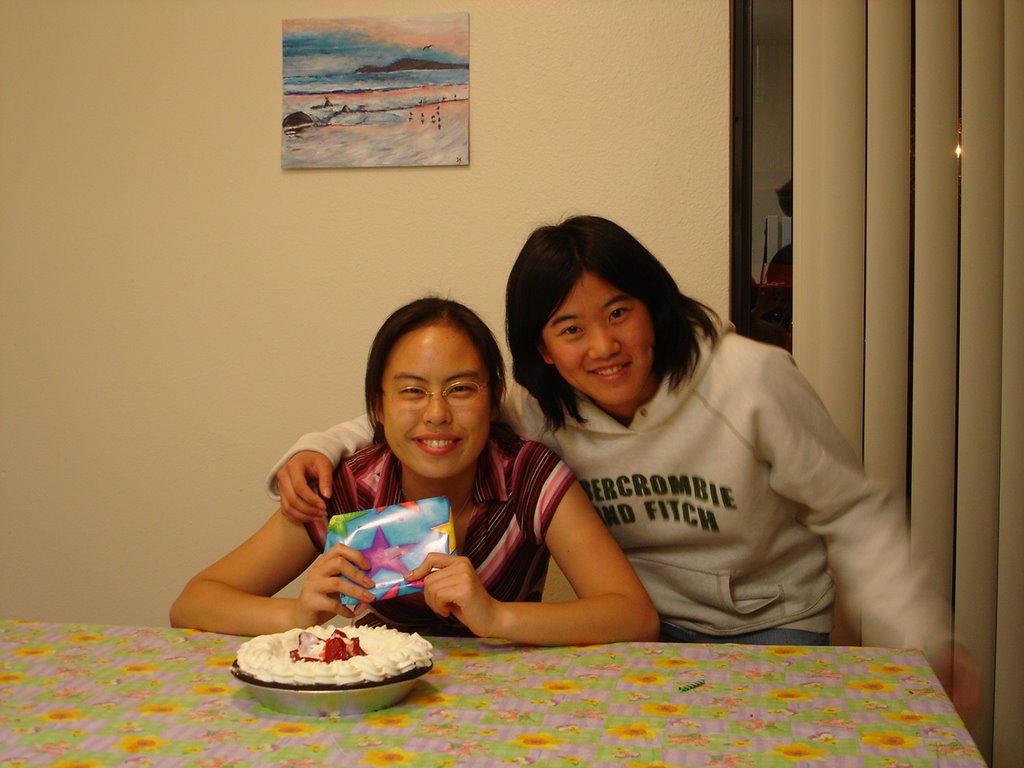
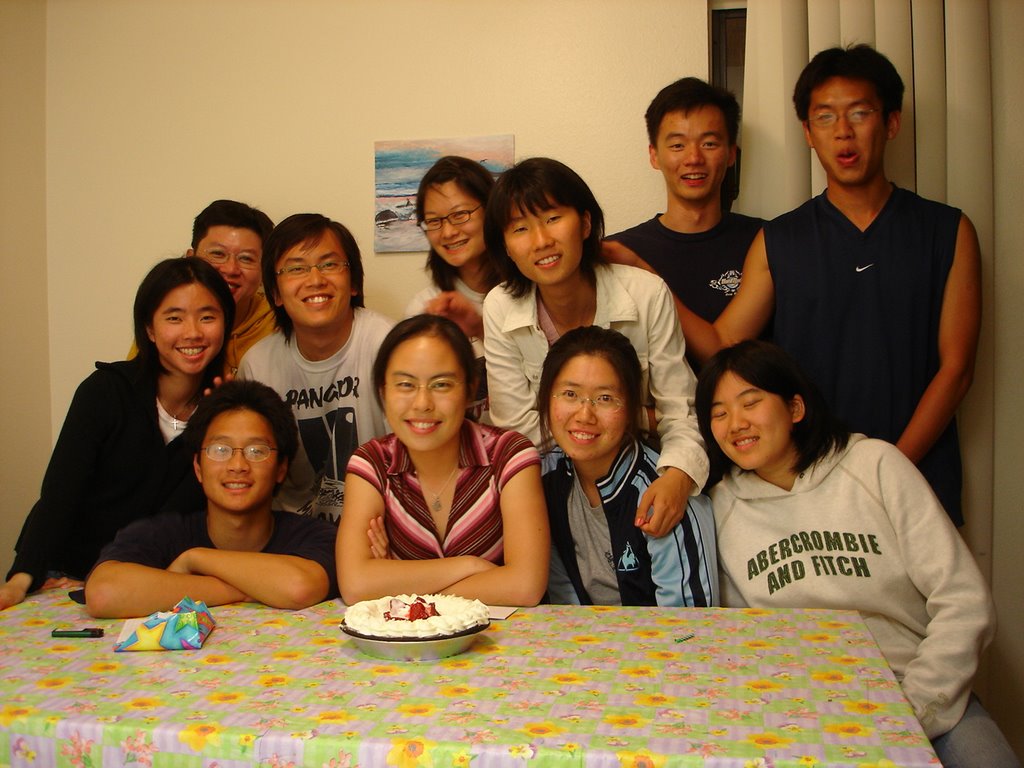
A trillion thanks to buddies who came today. and for the wonderful wonderful surprises!!!! the cd's really nice!!! thx jess..and man that bike's cool.. with that pantie ribbon lol... yay this is the best birthday! :) fantastica.. yoohoo!





Thursday, May 04, 2006

share your calendar

being a slow tech user as i am, moved myself onto 30boxes only today, (omg i haven't been blogging for so long almost forgot how to put links.) share your calendar with me, and feed it into your google home. :) and have you been on the quest?

Wednesday, April 26, 2006

I don't mean to rant

i don't mean to rant really. haha. there's a group on the facebook called "i'm taking too many units and now i'm f***ed." i would've joint the group if not for the very obscene profile picture. lol.
life goes on with me packing myself to max. even i don't know why i'm donig that.. well. at the same time the temptation of laziness and decent social interaction is like flies buzzing around my head. most of the time deprivation of sleep catches up as fast as school starts. sometimes i confidently think of dropping a particular class and smile at that very glorious decision, in a semi-conscious state when i'm about to pass out or before i fully awaken. only to realize that it is not as realistic as it appeared after i regain my consciousness, together with the realization of the coming of another disastrously prepared midterm to be taken one hour later.
i'll work.lol. i'll work.

on a lighter note, another reason why i'm feeling so slack might be that spring is finally here. well, it's been here for about a month or so, but lately the weather has gotten so warm that people've started wearing dresses and skirts. i love it when girls come out in skirts. :) with the sun and all, it just feels so refreshing. lovely sun...

and our spring has been fun, hiking and all into the warm sun in the montains and deserts near san diego. can't wait for summer to come and rid the place of that ramaining chill!

Sunday, April 16, 2006

We are what we pretend to be, so we must be careful what we pretend to be.
- Kurt Vonnegut

Friday, March 03, 2006

Wednesday, February 15, 2006

friendship day was fun. so got a rose from the guys justs like last year. and the rose was pretty.. thx :)

Thursday, February 09, 2006

flunked cell bio. ate nothing. swam 750 meters today. ah life sucks.

Sunday, February 05, 2006

for the first time, i envy those kids born in a country other than their parents'. they are so lifted from their cultural space. they don't have a history because they are not obliged to know any. they thus shed all burdens, which come penetrating into me from my place, my people, my history. i used to think of myself as being fortunate for the exact same reason, but now i don't any more. i envy them instead.

then this thing about cultural and socio-historical niche. i feel that this is what holds me back. nationalism and ethnicity. both hold me back from being completely freed into general objectivity. i cannot shake off prejudices and preoccupations because i was born and have been living with them. continue to fall into the trap of relativism. continue to discriminate. continue to be a hypocrite.

but i try very hard... :(
check server

Saturday, February 04, 2006

Thursday, February 02, 2006

the sunset is so nice


that i feel compelled to post this picture once again. oh geisel.

Tuesday, January 24, 2006

i was going to convert my air ticket from usd to sgd... and was too lazy to open calculator in my comp... so i was sorta thinking, google should be able to do it.. so i typed 1193*1.7 into the google search box on my safari. and the answer just loaded... cool
from the beautifully informative wikipedia:

The name Montparnasse stems from the nickname "Mount Parnassus" (In Greek mythology, home to the nine Greek goddesses — the Muses — of the arts and sciences) given to the hilly neighborhood in the 17th century by students who came there to recite poetry

Like its counterpart, Montmartre, the neighborhood of Montparnasse became famous at the beginning of the 20th century, referred to as the Années Folles (the Crazy Years), when it was the heart of intellectual and artistic life in Paris. Between 1921 and 1924, the number of Americans in Paris swelled from 6,000 to 30,000. In the years between 1910 and 1940, Paris' artistic circles gradually moved from Montmartre to Montparnasse.

Virtually penniless painters, sculptors, writers, poets and composers came from around the world to thrive in the creative atmosphere and for the cheap rent at artist communes such as La Ruche. Living without running water, in damp, unheated "studios" often as not overrun by rats, many sold their works for a few francs just to buy food. Jean Cocteau once said that poverty was a luxury in Montparnasse. First promoted by art dealers such as Henry Kahnweiler, today works by those artists sell in the millions of dollars. (how romantic! i wish i lived there..)

They came to Montparnasse from all over the globe, from across Europe, including Russia and Ukraine, from the United States, Canada, Mexico, and from as far away as Japan. Manuel Ortiz de Zárate, Camilo Mori and others made their way from Chile where the profound innovations in art spawned the formation of the Grupo Montparnasse in Santiago. A few of the other artists who gathered in Montparnasse were Pablo Picasso, Guillaume Apollinaire, Ossip Zadkine, Moise Kisling, Marc Chagall, Nina Hamnett, Fernand Leger, Jacques Lipchitz, Max Jacob, Blaise Cendrars, Chaim Soutine, Michel Kikoine, Pinchus Kremegne, Amedeo Modigliani, Ford Madox Ford, Ezra Pound, Marcel Duchamp, Suzanne Duchamp-Crotti, Constantin Brancusi, Paul Fort, Juan Gris, Diego Rivera, Marevna, Tsuguharu Foujita, Marie Vassilieff, Léon-Paul Fargue, Alberto Giacometti, Andre Breton, Pascin, Salvador Dalí, Jean-Paul Sartre, Henry Miller, Samuel Beckett, Joan Miró and, in his declining years, Edgar Degas.


Montparnasse friends. In the 1915 photograph in front of La Rotonde seen here, is (left to right): Manuel Ortiz de Zárate, Henri-Pierre Roché (in uniform), Marie Vassilieff, Max Jacob and Pablo Picasso


Montparnasse was a community where creativity was embraced with all its oddities, each new arrival welcomed unreservedly by its existing members. When Tsuguharu Foujita arrived from Japan in 1913 not knowing a soul, he met Soutine, Modigliani, Pascin and Leger virtually the same night and within a week became friends with Juan Gris, Pablo Picasso and Henri Matisse. In 1914, when the English painter Nina Hamnett arrived in Montparnasse, on her first evening the smiling man at the next table at La Rotonde graciously introduced himself as "Modigliani, painter and jew". They became good friends, Hamnett later recounting how she once borrowed a jersey and corduroy trousers from Modigliani, then went to La Rotonde and danced in the street all night.


more things to add on to my 1/23 post
come to think of it, i think the translation is crappy. the interpreter might have read too much into the poem, and said too much out loud. thus losing the poem itself. i shall get a dictionary and translate it myself. esp the last verse.

but oh, the more i listen to it the more i love it!

*** *** *** *** *** *** *** *** *** *** *** *** *** *** *** *** *** *** *** *** *** ***
i'm editting this post so that i can add in stuff.

the following poem is what i'm singing now. a poulenc setting on apollinaire. the poem talks about a poet, from Leipzig... curiously leipzig was described as "a small paris that educates its people".
why is the poet from Leipzig exploring paris?
of course there's the very familiar concept of the "gaze" which definitely reminds one of "flâneur" and every 20th century french artist. the unpredictableness. the eyes.
but why? where is there anything to do with bearing fruits? planting oneself?

and who is the bearded angel?

Montparnasse
--Wilhelm de Kostrowitsky

Ô porte de l'hôtel avec deux plantes vertes
Vertes qui jamais
Ne porteront de fleurs
Où sont mes fruits? Où me planté-je?
Ô porte de l'hôtel un ange est devant toi
Distribuant des prospectus
On n'a jamais si bien défendu la vertu
Donnez-moi pour toujours une chambre à la semaine
Ange barbu vous êtes en reálité
Un poète lyrique d'Allemagne
Qui voulez connaître Paris
Vous connaisez de son pavé
Ces raies sur lesquelles il ne faut pas que l'on marche
Et vous rêvez
D'aller passer votre Dimanche à Garches

Il fait un peu lourd et vos cheveux sont longs
Ô bon petit poète un peu bête et trop blond
Vos yeux ressemblent tant à ces deux grands ballons
Qui s'en vont dans l'air pur
À l'aventure (goodness! that glissando poulenc wrote! it's enchanting! )

Montparnasse
--Apollinaire

Hotel door, amidst verdure
Verdure never to produce
Vast, luscious bouquets
It must vex me - shall one bear fruit? can one plant oneself?
Hotel door, a lone angel stands adjacent
And issues prospectuses
Virtue's never been so protected
Allocate me a small weekly room for ever
Unusual bearded angel, in truth
An eloquent Leipzig poet
Sent on a momentous quest to explore Paris
Be sure not to step upon lines on the pavements
And dream of
An exquisite Sunday rendezvous at Garches

It turns excessively humid, long-locked
Juvenile poet, jejune and so pale
An unusual gaze resembles a pair of vast, oversize bubbles
Set to venture upon pure, tranquil air
With evasive, quiet unpredictableness
i know what's wrong with aroian. he looks like mr bean

Monday, January 23, 2006

From wikipedia:

His inclination towards relations with younger men was relatively well-known, the first such relationship having probably been with Robert Ross, who proved his most faithful friend and would be his literary executor. Ross, a boy of seventeen when Wilde met him, was already aware of Wilde's poems and indeed had been beaten for reading them. By Richard Ellman's account, Ross, "...so young and yet so knowing, was determined to seduce [Wilde]."

the last sentence... i don't know why. there seems to be such beauty in what's described... gave me the shivers when i read it.
Oscar Wilde (1854–1900). Poems. 1881.

32. Chanson


A RING of gold and a milk-white dove
Are goodly gifts for thee,
And a hempen rope for your own love
To hang upon a tree.

For you a House of Ivory 5
(Roses are white in the rose-bower)!
A narrow bed for me to lie
(White, O white, is the hemlock flower)!

Myrtle and jessamine for you
(O the red rose is fair to see)! 10
For me the cypress and the rue
(Fairest of all is rose-mary)!

For you three lovers of your hand
(Green grass where a man lies dead)!
For me three paces on the sand 15
(Plant lilies at my head)!

from wikipedia: After graduating from Magdalen, Wilde returned to Dublin, where he met and fell in love with Florence Balcome. She in turn became engaged to Bram Stoker. On hearing of her engagement, Wilde wrote to her stating his intention to leave Ireland permanently.

this poem must have been written then. i was guessing at the masterclass today that this poem should not be read as morbid, because wilde is such a person who would beautify and romantisize death. looks like it's only an ordinary love poem and indeed should be morbid. but undeniably, i think wilde is romantisizing the whole out of love business, and making it sound more morbid than it actually is. in fact, i read a seduction in the lines. the seduction of death, and a bewilderness, rather than morbidity. well. depends on how you look at it.
sigh
for once i got up for my biochem lab lecture which is frickin at 8am i couldn't find anybody in the classroom... went to the lab no one's there either... i checked my timetable again, no mistake in room number or anything. where would the lecturer hide the class?
so i called for help and was told that there was no lecture on mondays even though it was printed on my timetable cos the excessively naggy lecturer said that she didn't need it--in the first class. the first class was the only class i went for... even then i didn't hear it being said. (and considering how naggy she is she might have said it 3 times.)(well i might as well not go for classes since i don't hear anything.) moral of the story, when i have a naggy lecturer, i shut down. so. must be careful next time when i sign up for classes.

Tuesday, January 17, 2006

winter job and internship fair on library walk
microsoft has the biggest banner
ibm
lawrence livermore nat lab only has a piece of paper with name printed
there was also hcbc, hitachi, blah blah
no google, no apple

a guy standing in front of the recruitment booth of "the great seal of the state of california" (what's that?) and made an inquiry, the recruitor replied "teaching chinese? no.. we don't have that...em, what other languages do you speak?" that guy shrugged and answered "er.., taiwanese?"
er, excuse me, that's not a language.

which reminds me of another joke. when i was applying for social security number, i habitually signed the paper with my chinese signature. that officer looked at me and said, no you have to sign in american letters.

Monday, January 16, 2006

I found a copy of Yishu - Journal of Contemporary Chinese Art in the library, published by Art & Collecution Group Ltd in Taiwan. i have seen some of the works in the exhibition of chinese contemporary art in the UCSD art gallery last year. i found them impressive then, and am exhilarated to see them again now.

we can look at some of the works in this and my subsequent entries. today i will look at xu bing's works.

xu bing was born and educated in china, has been through cultural revolution, and received an MFA from the central academy of the arts. after many works had been censored by the central government, he moved to new york, and continued to live and work there till today. he appears to be one of the group of chinese artists/musicians in whom i've newly developed a strong interest, i.e., whose who were trained and were active in the 80's immediately after the end of cultural revolution. (another example will be tan dun.) the clash of completely contradicting values at the interface between eras gave them distinctive world views and philosophy of composition.

the interview in Yishu mentioned a number of his works. one of them is a book from the sky, which was created while the artist was still in china.

(i forgot to bring a camera with me. well i have to type the thing down. but it's worth reading.)

Q: starting from your earliest works, such as the creration of a nonsensical language in a book from the sky, the nonsensical theme has been prevalent in your work. how did you first conceive of this theme, and why were you interested in this notion of "meaninglessness"?

A: Acutally, these ideas arose from my personal experiences in china. for one, i felt a sense of boredom and cultural ennui, a feeling that culture was meaningless. this was at a time when mainland china was going through a period of "culture fever". that was during the eighties, and the cultural revolution had just ended. government policies were becoming more relaxed, and many new forms of culture were flourishing on the mainland. we were simultaneously flooded with new books and ideologies, from traidtional chinese thought to contemporary western culture. this period produced a profound effect on the thining of chinese youth. i was a graduate student who participated in the many cultural debates and popular movements during those days . after attending so many events, i became tired of the process and felt quite disillusioned by culture. during the cultural revolution there was a starvation of knowledge and culture; once the revolution ended, ther was an overabundance of it. somebody who overeats right after severe hunger will end up feeling very sick. there was a huge gap betweeen our expectations for culture and what was received in the end. this resulted in a feeling of emptiness and powerlessness in the face of culture.

Q: when you were a student, what were your thoughts and feelings about the foreign ideologies coming into china?

A: it was a very ambiguous experience because many of the new ideologies were presented in fragments, in little bits and pieces. the ideologies being discussed wer very incomplete. there was no way to ground the ideas, nor was there a clear direction for the future. all we knew at the time was that we were coming out of our old ways of thinking and our old ways of art making. but we had no idea of how to proceed or where the new art would take us. it was a period of chaos and confusion. speaking from my personal experience, it was very easy to feel bewildered and lost.

(comment: i believe, his personal experience is easily everyone else's.)


according to xu bing, the work was censored because the government was over-interpreting it's political message while the work itself had little such intention.


Q: Why did the chinese government censor your works at that time?

A: at the time, the chinese government was still strict in its policies, especially after the events of TAM square. before TAM, the poliecies were more relaxed and therefore many young intellectuals and artists came onto the scene a book from teh sky also appeared at this tiem. yet shortly after, the TAM protests bro out and the poitical crackdown caused an extreme reversal of teh stae's relaxed policies. contemporary artists came under political critique. while a lot of contemporary art appears on teh surface to be whimsical adn transparent, a book from the sky was different because people could not figure out what it was saying, yet it was meticulous, rigorous, and monumental in effect. officials thus assumed that it embodied the most sinister elements of contemporary art and singled it out for public critique. the authorities branded it as one work that embodied all ten wrongdoings of new wave art. (comment: i'm confused here. was there a new wave movement in chinese contemporary art? i've only heard of the new wave mvm in french cinema la Nouvelle Vague.)

Q: instead of exposing the formal structures of language through nonsensical characters, square word calligraphy

creates work with meaning and functional use. can you comment on this departure from your earlier works?
(comment: to clarify, square word calligraphy is a way of writing english words in chinese strokes assembled in a way similar to the square characters in chinese writing. but the words together, reads like an english sentence.)

A: actually, this work involves my artistic experimentation in the contemporary art scenen of the west. i became troubled by the hierarchical relationship between contemporary art and its public audience. when people enter an art museum it is as if they have entered a place of worship. too many audiences feel bewildered by the art they see and react with a feeling of guilt, as if their confusion reflected their own lack of education in art of culture. in fact, many works of contemporary art art lacking in thought and creativity, although they present a shocking appearance to teh audience. i hope that my works are clear and easily accessible to audiences. once they are engaged in it, i hope that the audience can discover the deeper meanings in teh work and become inspired in their own ways of thinking.

Q: How do you explain the hierarchical relationship that has been established between contemporary art and its public audience?

A: i think this relationship is a basic aspect of contemporary art. one can trace it to duchamp, who levelled the relationship between art and life. this was a powerful revolution, however, in the process of levelling the relationship of art and life, he left the artist with a certain privileged status. because i am an "artist", anything i do is automatically given value and maning. this notion actually caused the decline of creative though within contemporary art. since i have this status as "artist", anything i do is vlid. i'm making art if i sweep the floor as a performance artist, and this may be considered different from a regular sanitation worker who sweeps the floor. in reaity, there isn't a whole lot of difference.

(comment: i think his view on the hierarchy is quite objective. i have heard enough of sweeping statements about contemporary art. mainly one side saying that modern art is all crap and the other saying that the first side is illiterate in art appreciation. in fact, there are definitely artists who do not live up to the creative and serious thinking of avant garde, but there are still a great many of them who take the business of creativity seriously, whose works involve a great deal of hard work.)

Sunday, January 15, 2006

because of my mother's recommendation, i watched this film. incredible performance and production: Wit by emma thompson

as professor vivian bearing was diagnosed with and hospitalised for stage 4 ovary cancer, she was caught in the overwhelming battery of tests and treatments, taking tremendous pressure both psychologically and physically. as she makes her way through the daily pain and humiliation, she started to reflect on her fascination with english words, her life as an "uncompromising scholar", her cool and strict teaching, and the meaning of life and death in a concrete way.

the subtlty of the emotions depicted in the film was extraordinary. emma thompson, as usual, was more than apt to act as an intellectual with incredible depth of thinking. moreover, her gradual revealing of the vulnerability of professor bearing and change of her mindset, or even world view from the earlier part of the film to approaching the end was just done to perfection.

wonder why this film was only screen on TV and why it didn't win many awards. anyway, very thought-provoking. worth watching.


"The sonnet begins with a valiant struggle with death, calling on all forces of intellect and drama to vanquish the enemy. But it is ultimately about overcoming the seemingly insuperable barriers separating life, death, and eternal life.

In the edition you chose, this profoundly simple meaning is sacrificed to hysterical punctuation:
And Death-capital D-shall be no more—semicolon!
Death—capital D—comma—thou shalt die— exclamation point!

If you go for this sort of thing I suggest you take up Shakespeare.

Gardner’s edition of the Holy Sonnets returns to the Westmoreland manuscript source of 1610, not for sentimental reasons, I assure you, but because Helen Gardner is a scholar. It reads:
And death shall be no more, comma,
Death thou shalt die.

Nothing but a breath, a comma, separates life from everlasting life. It is simple really. With the original punctuation restored, death is no longer something to act out on a stage, with exclamation points. It’s a comma, a pause.

This way, the uncompromising way, one learns something about this poem, wouldn’t you say? Life, death. Soul, God. Past, present. Not insuperable barricades, not semicolons, just a comma."-professor e.m. ashford

religious content aside, this is still true. nothing but a breath, a comma, separates life from, well, i would say, death. lol. but yah, this paragraph here was excellently analysed.

A Must See Photog Site

a feast of images

i'd always thought the beauty of ucsd campus should lie in its colours, maybe because of the sunny weather, if not in the buildings, at least in the trees and the flowers and the sky. maybe not. from this guy's photos, the beauty of the campus seems to lie in its geometrical appearence, in its angular presence, of not only the buildings, but also the trees and everything else.

and ah, perspective. perspective. always different perspective.

Saturday, January 14, 2006


Sweet and calm moonlit regents parking lots


and then there was an alien invasion!

Thursday, January 12, 2006

i've never particularly liked the clarinet until i heard messiaen's quartet for the end of time today. that clarinet solo in the third movement Abime Des Oiseaux is just stunning- i have never imagined so many different effects and texture coming from that instrument..resembling birdsongs. so rich in expression, so much life. actually constructs a sense time and space...cool. so THAT is what a clarinet can do!

Wednesday, January 11, 2006

i had a bad audition today. never imagined myself in such a situation before. i was actually, a real object worth detesting, a vocalist out of tempo... i mean, i'm really not that strong in rhythm, but to be embarrassed in front of a ton of instrumentalists is too much. i felt that everyone looked at me as i was some pathetic person who needed help, or worse, was beyond help. janos didn't comment much, he didn't comment on anyone's playing except a violinist, about whom he said good. of course, that guy played tchaikovsky's concerto no. 1 and made it through. well. here i am, out of the comfort zone of voice lessons (really, with a bunch of forgiving and equally out of tempo friends, and an accompanist patiently following me through thick and thin, fast and slow) into the harsh reality of mus 130. at least at the end of the audition, i have already got a partner and a piece... lakme that is. flower duet. i've wanted to do this for a long time.

Saturday, January 07, 2006

ok. here's the thing, Mo. and mo, you still do talk to strangers don't you?
From Mo the Psycho Princess

Rules of the game:1. Post 5 weird/random stuff about yourself.2. At the end, list the names of 5 people whom you want next to do this, and leave a comment "YOU ARE TAGGED!" in their blog and tell them to read your blog for rules.


1. I have weird thoughts often, when i am about to fall asleep. such as, a huge blade cutting across me and then me being lifted up. or me being inserted into a metal tube that has a blade edge and is smaller than my cross section. it's not that i feel or see it. but i think about it and wonder what it would've been.

2. sometimes when it gets to the sad part in movie i can't help smiling. well. don't think that's unique though.

3. i don't like neat and tidy rooms.

4. i am plowing very slowly through da vinci code. and am still half way through...

5. i'm really not weird..

i'm tagging: zhu, ya, mg, carine, an.. :)
School is starting in two days. i'm again hugely successful at procrastinating.
1. montparnasse, not learnt (let's wish fiona doesn't kill me)
2. ivf still not working
3. da vinci code, still not finished
4. lab website, still kind of empty
5. feynman's EASY pieces, still half done
6. essays for faces, due tue. still not started.

wonder how come i am so calm sitting here typing these things down.
and i'm sleepy. off i go.

Friday, January 06, 2006

it's nearly one year since i moved my blog here.. ooh. new backdrop for a change :)
i took the picture of this birdy near international house on campus. the sky is of an impeccable colour... and the bird has very nice posture :) good for me. hee.
The most important scientific revolutions all include, as their only common feature, the dethronement of human arrogance from one pedestal after another of previous convictions about our centrality in the cosmos.
- Stephen Jay Gould

well said, indeed. what i have always meant to say put in words nicely.

Thursday, January 05, 2006

Wah lao. msn actually designed its photo album function in msn space only for IE6, the lousiest browser on earth. man what would pc users feel if ipod were exclusive for mac users...

Wednesday, January 04, 2006

failed to get up. must do ivf tmr!

such is the view outside my lab on a foggy winter night. i somehow feel that there's some kind of presence on the chair.


oh yah, and i just spent the last couple of hours redoing the lab website... here it is. my first website ever. well..at least all the hyperlinks worked
today i tried in vitro fertilization for my fish for the 3rd time. still didn't work. how hard is it to fertilize a bunch of eggs with the sperms right?

but i saw the most amazing thing under the microscope at 80x mag. the sperms are inactivated at high salt concentration (hank's balanced salt solution with 4.2 mM sodium bicarbonate) so they just looked like tiny dots not moving. once i added egg water into the solution, they instantly got activated and started swimming. cutest thing in the world! i could hardly see their tails, but i would think they have them...

which means the sperms i collected were fine. that means the eggs were bad. fine. i'll get up early tomorrow, i mean today, morning to do the dissection at the egg's prime time. well... sighz..why is there such a thing as biorhythm!!

and i don't suppose any of you guys sequence fosmids of 40 kb size right? just in case you do.. how do you yield results with fosmid sequencing? it just doesnt' work. i've tried different primers. maybe i need to digest it. anybody?
since i quoted that paragraph in the last thread, here's another great exerpt from Colm Toibin's The Master:

Gradually, then, over the days, Minny Temple made a choice. She chose subtly and carefully so that no one saw at first that she had done so, but what was no apparent to Gray or Holmes or her sisters became clear to Henry because she wished it to be clear to him. She chose Henry as her friend and confidant, the one she trusted most, could speak to most easily. And she may have chosen Holmes for something, too, because she never ignored him, or shone her light on the others more than on him. But she chose Gray as the one on whom she could have most effect, whom most needed her. She paid no attention to his military talk and his gruff, practical comments and his clipped witticisms. She wished to change him, and Henry watched her gently cajoling him, without allowing herself to become offensive.


how apt.

Tuesday, January 03, 2006

Solitude

i thought i like solitude more deep inside.. seems that i'm not enjoying it very much these days that i'm alone at home... been only half a week since i was left alone in the apartment and i'm just really bored. solitude.. not my cup of tea.

but travelling alone is still a romantic idea. on my way back from san francisco on the amtrak train (again), i wrote:

it's only on the train i feel that i'm traveling at all. you never feel this way on an aeroplane, solely for the brevity of the trip itself.

right now i'm traveling down from sf to sd, on an amtrak train through the californian country. there would've been some good view outside the window, if only it wasn't so rainy today. but the overall gray tone of the fields does give a serene feel. too bad my camera won't take much of the calm atmosphere. all that it captures is the gray and dead gloom.

i like the romantic notion of a drifter, which i pretend to be whenever i'm traveling alone. it's only during those lonely trips that i can imagine that i'm the heroine in some kind of art film, a drifter, hugging my bag in a slow moving train, among the strangers, with no destination in mind, only involved with the scenery, only involved in observing what's around me. a lost person. a flaneur. a break from the always directed and always purposeful life.


and was also reminded of a paragraph i read before:
He put the letters aside and sat with his head in his hands. He did not help her or encourage her, and she was careful never to ask out-right. If she had insisted on coming, he forced himself to complete this thought now, he would have stood aside or kept his distance or actively prevented her coming, whatever was necessary. He had himself, in that year, escaped into the bright old world he had longed for. He was writing stories and taking in sensations and slowly plotting his first novels. He was no longer a native of the James family, but alone in a warm climate with a clear amibition and a free imagination. His mother had written to say that he must spend what money he needed in feasting at the table of freedom. He did not want his invalid cousin. Even had she been well, he was not sure that her company, so ful of willful charm and curiosity, would have been entirely welcome. He needed then to watch life, or imagine the world, through his own eys. Had she been there, he would have seen through hers.

Monday, January 02, 2006

i dislike people for exclaiming "Ooh this place/person/thing is so classy" and looking fascinated to death just because the object described is:
1) old
2) expensive
3) snobbish
4) french

Sunday, January 01, 2006

Behold! the last painting i do before a long period of futility


I thought i should start to explore other colour schemes... this one not particularly successful. but well... who likes pastel anyways.
..and school is starting again. bye to brushes and paints.

Thursday, December 29, 2005

brought my friend to the sea world. been in san diego for 1 and half year strangely i've never been anywhere like the sea world or zoo... but, was very fun today. we were watching the shamu show, suddenly the host on the big screen said that somebody has sth to say. and the camera focused onto this couple in the audience. and suddenly the guy just knelt down to propose to the girl, who was like totally struck by surprise and love.. haha. never thought i would see sth like that in real life...

and brought her to la jolla shores beach too. the sea at night never fails to amaze me. never. so wet, so fresh, so crude. so powerful. that deafening sound. as if it was going to swallow me... watching the waves break. and feel its vastness. its vitality. its playfulness... such things. can never be recorded anywhere. not on a picture, a tape, or a film... you have to be there to feel it. all of it. and then absorb as much of it as possible. and bring it back home. how fascinating!! the sea...


sorry.. i didn't have a tripod..

Tuesday, December 27, 2005


half done painting... any suggestion?

Sunday, December 25, 2005

What is this supposed to mean?


I'm most surprised to find this on the Bart train from Berkeley to San Francisco.

Oh yeah, something that only passion can sustain

Read this if you plan on doing a PhD

ah hah

this totally explains my problem:

Being a Bimbo


(mo i'm sorry i'll do your test soon...)


a trip to the bay area with my beloved and trendy friends has totally turned me into a bimbo. we shopped and shopped, for clothes, for shoes, for earrings, for handbags. we took photos everywhere. we laughed and screamed. and walked around like bimbos. man. although i have to say that the berkeley area has way too many homeless people for me to feel comfortable looking like a bimbo in the streets, i still had quite a bit of fun.


and then back to the question. can i really be a scientific bimbo? the phrase itself seems to contain irony... i admit that i'm at times torned apart by the totally opposite ways of life. a materially insipid lab rat life that gives me more than enough intellectual stimuli to last for a life time, and a life with food and fashion and glitter and shimmer, and chatting with girlfriends, and talks about love and life and boys, and endless shopping to improve our looks. i don't have time for both. the choice has been made. well. i only have a tiny taste of it over the very very short vacations that i take outside the lab. and that was good lol.. but no matter how tempted i get, fate gets me into the life of Piled Higher and Deeper.

talking about conflicting interests and distractions and stuff, i called my mom when i was shopping in the forever 21 in san francisco. i went "mom there are so many shops...gosh this is terrific...berkeley is such a convenient school i wish i had applied here instead of that deprived la jolla..." she calmly replied "oh really. i'm glad you didn't then."

Friday, December 23, 2005

New for criticism

  I waited, but you turned away.

Thursday, December 15, 2005

george died.

when we went to the apartment office today to get a mouse trap, they told us that a little gray mouse was caught near that apartment. that must have been george... sighz.

mouse

friend's apartment has a little gray mouse called george... wouldn't come out from below the oven despite the fact that we called him a lot of times..

Thursday, December 08, 2005

USSR

why did prokofiev take part in the USSR national anthem competition?

Thursday, December 01, 2005

Eliminative Materialism

I have been thinking about this topic for indeed a long long time. (i.e. more than 3 weeks.) To summarise everything, here's the the essay that i wrote for my phil class. my professor Paul Churchland, together with his wife Patricia Churchland are among the top brains working on philosopy of mind, and active advocates of the shocking theory of Eliminative Materialism.
anyways, here's the thing...(i know. it's like a hundred pages...)

We talk about what goes on in our mind all the time. “I feel hungry.” “I love apples.” “I believe I should do this essay.” We are so used to this way of talking about our inner life that we cannot imagine living without it. Therefore, eliminative materialism naturally came as a shock. The eliminative materialist claims that common-sense psychology, or folk psychology, which is the way we talk about all mental states, is false, and the mental states talked about are non-existent. In the place of folk psychology, neuroscience will offer us better alternative understanding of the human mind, and eventually we will adapt to talk about mental phenomena in accurate biological vocabulary.

Before we analyze the theory of eliminative materialism, we shall first look at the theories of mind currently available and their limitations.

Opposing all materialistic views as a group, we have dualism, in which mind is believed to be a separate entity. Substance dualism, which states that mind is made of a different substance, cannot get rid of the problem of how the non-physical mind causally interacts with the physical body. Its inconsistency with the physical causal closure thus keeps the argument from being convincing. Popular dualists, who claim that mind is a different form of energy, like substance dualists, still owe us evidence that shows mind’s capability to exist without the brain, since the mind and the brain are distinct substances. Epiphenomenalists, although avoid the burden of showing that mind can exist without the brain because they believe the former is dependent on the latter, risk the danger of rendering any physical system, like a rock, as having mental states. All forms of dualistic views argue from introspection that they can only conceive mental states as being distinct from the physical things, but introspection might be as in accurate as our external sensations. Just like we cannot see the true identity of light as being electromagnetic waves because our eyes do not detect any other electromagnetic waves, our introspection might be just as limited and inaccurate in revealing the essence of our mental events. Moreover, when we use introspection to prove the existence of mental states, or to try to characterize it in any sense, we are actually using a mental process – introspection – to prove the existence of mental states. As the premise depends on the conclusion, this enters a circular argument.

Behaviourism defines mental states as what determines the behaviour or potential behaviour of the subject. By not directly addressing the nature of mental states gets away with many problems that dualists run into, but it cannot solve the problem of infinite combinations of behaviour, which makes definition of mental states difficult. And it still does not explain what mind is essentially and leaves a lot to be questioned

While the dualists and behaviourists failed to counter their difficulties or give any positive account to characterize the mind, materialists have learnt much from advances of sciences. The materialists believe in the existence of the physical brain, and the neural dependency of the mind on the brain. An identitist is firmly convicted that a physical system is necessary and sufficient to explain our mental life, and aims to match our mental states and brain states in a one-to-one fashion.

Development in neuroscience provides a platform for the identitists to make the connection between physical states of the brain and mental states (as we commonly understand them). As mentioned before, damage to brain parts leads to reproducible and specific loss of function in mental aspects of the patients. This pinpoints to a possibility that the identitists are right. The identitists believe that the sensation of pain is neither a non-physical substance nor some epiphenomena of the brain, but the event of firing C-fibre itself. Overall, the identitists suggest a scientific reduction of complex theories of mental states to simpler theories of brain states. There are many historical parallel, such as temperature being reduced to the average kinetic energy of molecules and lightening being reduced to electrical charges in the atmosphere. When two objects turn out to be the same, one is identified with and reduced to the other. In some cases, identity theory seems to work pretty well because some correspondence between mental states and brain states does seem to exist, with our current understanding of neuroscience. Seeing light seems to be identical to the event of rhodopsin being activated and leading to a series of subsequent biochemical pathways. Tasting sweetness seems to be taste receptors in the tongue stimulated to activate downstream pathway that leads to firing of a certain group of neurons.

One standard objection to identity theory, which is also an objection to all materialist point of views, is the argument from introspection. I do not perceive biochemical pathways when I introspect, but I perceive the sensation that identitists claim to equate the pathways to. I can see light but I have no awareness whatsoever of the function of rhodopsin. Identitists are seen to have not taken into account the experienced nature of mental events. This objection, however, does not stand, because of the fallibility of introspection as I have explained before in the section on dualism. There is anther objection, though, that the identity theory cannot avoid. Not all organisms achieve a certain mental state, for example pain, by the same mechanism, for example C-fibre firing. C-fibre firing is the process that results in only “pain” in human. In a worm, it is reasonable to suggest the presence of a percept analogous to the human “pain” but that is caused by firing of another fibre. In this case, it becomes unclear what pain is identical to. Therefore, a one-to-one reduction does not seem to work in all cases.

In order to solve the problem with matching that identitists encounter, functionalists suggest that what defines a mental state is its relationship with external environment, behaviours and other mental states. Putting mental concepts back into the abstract realm, the functionalists do not have to show that physical brain has any correspondence with the mind. Therefore they believe that the advances in neuroscience will not tell us much about mind. Objections to functionalism include the Inverted Qualia (person with inverted colour sensation but functionally normal) and Absent Qualia (China Brain). If mental states are only determined by functions, person with inverted colour sensation should have normal mental states, but clearly he possesses totally different mental experiences. Similarly, it is hard to conceive the population of China having any macro mental states although as a whole it is logically functional like a group of neurons or computer hardware. In response to such objections, the functionalists have to address the identitist point that there is something in the physical brain that corresponds and determines mental states, hence contradicting their purely functional definition of mental states.

Identitists and functionalists go through much struggle with matching the mental states as we usually understand them and what actually happens in the brain. Such efforts also penetrate the dualist views in order to explain what interactions actually go on between the mind and the brain. Mismatch of the mental states and brain states, often poses challenges to the aforementioned theories. Since the physical presence of the brain cannot be denied, it is tempting for a materialist, to reject all of the above theories and declare the mental states that we have been trying to explain empty and false. Elimination of mental states dissolves such difficulties.

Folk Psychology, or common sense psychology, is a theory that has been postulated by humans to explain others’ behaviour by simulating similar events in themselves, and then used to predict and eventually manipulate others’ actions. Our daily talks about beliefs, desires and emotions are all within the range of folk psychology. The formation of folk psychology is similar to that of other folk sciences in that the postulation of such theories is distinct from the strictly logical methodologies used in modern scientific generalizations. Like ancient mythology, the folk sciences and theories seem to be mere speculations about overtly complex phenomena that are beyond the means of investigation in that particular time, which definitely lack accuracy and credibility.

The eliminative materialist argues that folk psychology is partially or fully mistaken. Since the mental states that we understand and talk about are completely in the folk psychological sense, they might very well not exist at all once folk psychology is false, hence leaving only brain states that exist in reality. The eliminative materialists hence carries the discussion further by suggesting that since there are only brain states in reality, thorough studies in modern neuroscience will be necessary and sufficient to understand our mental phenomena.

The suspicion that folk psychology is falsifiable can be argued from two angles. Firstly, folk psychology does not represent our mental states fully, or even correctly, especially when compared with modern tools of neuroscience that can potentially offer us much more complete understanding of the nature of human mind. For example, nowhere in folk psychology are phenomena such as consciousness explained, nor do we learn anything about learning and memory from folk psychology. Theoretical and experimental neuroscience sets out to find the neuronal correlates of consciousness, learning and memory, and have already yielded promising results for some of the mechanisms involved in such mental activities. More often than not, folk psychology gives a wrong explanation for phenomena too complex for understanding. For example, folk psychology offers demon or witchcraft as an explanation for psychotic behaviours and hallucination in schizophrenia, which has already been determined by modern neuroscience to be a mental illness caused by nothing more than abnormal levels of the neurotransmitter dopamine. While folk psychology does not offer treatment because of poor understanding of the cause, modern neuroscience has succeeded in attenuating the symptoms of schizophrenia by externally administering drugs to adjust dopamine level. In any case, as a theory, folk psychology seems stagnant in its progress of understanding the mind problem, seems wrong when it does give an explanation and fails to predict mental phenomena accurately. This leads us to suspect the occasions when we think folk psychology is right. It is possible that we are so used to the system of thinking that we do not realize many other wrongs of folk psychology.

Secondly, folk psychology encompasses a system of representation of mental states in the form of propositional attitudes. Propositional attitudes are statements like “I believe P”, which has a syntactic characteristic. In other words, according to folk psychology when we express, understand or even just think about our own or others’ mental states, we think in terms of sentence-like structures. This is begging the question of whether we really do that. It is hard to conceive that infants, for example, when they first start interacting with the social environment before they learn the language, do not have any thoughts. Similarly, patients with mental illness that leads to a loss of linguistic functions also clearly lead a life with perfectly normally functioning sensations, emotions and desires. We have also experienced the situations in which we cannot describe in words the sensations or thoughts that we perceive. If we really sense, feel and think in a syntactic structure, this is not likely to happen. Therefore, language-like structure does not appear necessary for formation of thoughts in the brain, and folk psychology which bases its theory on syntactic structure of mental states seems wrong. On the other hand, if we abandon this theory of folk psychology and start to examine our so-called mental states on the ground of basic biochemical interactions in the physical brain, we might be able to find some other theories, more accurate and fundamental ones, that can explain how we simulate thoughts and sensations at all.

From the general narrative of scientific history, we observe a trend of folk sciences being eliminated. Folk physics used to prevail as a tool for human understanding and prediction of the natural world, but its mistakes slowly revealed as more scientific and modern physics theories developed. For example, the mistaken calorie theory was replaced by the correct theories of thermophysics. Such replacement has to be distinguished from a change of theory of light to the theory of electromagnetic waves. The former is an elimination process, and the latter is a reduction. Light can be reduced, or identified with electromagnetic waves because the two are essentially referring to the same thing, only that the second one is a more fundamental mechanism than the first. Here reduction is possible. In the case of calorie theory, a scientific reduction is not possible because the theory of calorie is fundamentally wrong, i.e. a substance such as caloric fluid does not exist in reality at all. Thus the concept of calorie has to be eliminated. Similarly, since folk psychology has been wrong in many cases, there is a very good chance that our so-called mental states do not exist and are irreducible to the objectively existing physical states of the brain, but has to be eliminated all together.

The eliminative materialist point of view is radical. It is definitely not easy to think that what we have been talking about for millennia, such as “I love Peter” or “I feel hungry” turns out to be false. If the eliminative materialists are right, then a new set of language has to be adopted for us to talk about our brain states (since mental states are no longer viable). This has happened before in history, however. The once prevalent phlogiston theory of fire is rarely discussed now because it has been proven wrong, and gradually people learn to drop the word “phlogiston” from their daily vocabulary. This illustrates that our language and ways of talking about things evolve as our understanding of the external world develops. The same goes for knowledge about ourselves. The elimination of folk psychology can be a long process, because it concerns ourselves and folk psychology has been around for as long as we can remember. As long as it is proven wrong, however, it is the logical and necessary thing to do to eliminate folk psychology eventually.

Some might complain that this theory dose not actually offer any explanation as to how mind works. On the contrary, I prefer this theory precisely because of its open-endedness. Firstly it has shed the burden of trying to explain the discrepancies between mental states and brain states by invalidating the former. Secondly as he eliminates folk psychology as a theory of the mind, eliminative materialist turns to modern neuroscience for alternative theories of how brain gives rise to mental events (not in the common sense of folk psychology). As our understanding of neuroscience is still rudimentary at this stage, it is not surprising that there are not thorough and satisfactory theories being offered. However, the elimination of common-sense mental states is an important step to opening our eyes to an array of new theories that might potentially be right. These theories will be formed and tested by tools of modern neuroscience, by scientific experimentation and logical deduction and are bound to be more complete, accurate and specific than the arbitrary and out-dated folk psychology.

One other objection states that if folk psychology as a theory and thus beliefs should be eliminated, then how can eliminative materialists themselves have a belief at all. To this objection, the Churchlands responded by saying that the eliminative materialist uses a belief to argue his case for elimination because he has no choice but to think in the context of folk psychology. This does not mean that folk psychology is therefore true, but only shows that there are no other conceptual frameworks available for the time being. (P.S. Churchland 1986).

The eliminative materialist suggests that when deemed not right, a theory is eliminated and a better theory is put in place of the first one. We cannot, however, be sure that the second theory is necessarily true, because there is indeed a possibility of an even better theory replacing the second one. As such, some worry that this suggests that all scientific theories are either false or potentially false and there will be no truth. I cannot say that this is not what happens, but I think that we can just do with the best theory we have, as long as it serves our purpose in its time. Folk psychology however, has proved to be wrong in many cases, thus the replacement of folk psychology with new theories from neuroscience is inevitable.

In conclusion, what eliminative materialists suggest might be true and just like the elimination of phlogiston, folk psychology will be replaced by a more sophisticated and accurate system of representation of our brain states, which is necessarily to be devised by advances in modern neuroscience.

In response to a recent inquiry

"They say I'm dry at heart. That's wrong and humiliating. I am Basque. Basques feel things violently but they say little about it and only to a few."

--Maurice Ravel

Tuesday, November 29, 2005

nightmare

content not suitable for underaged

so i had the strangest nightmare yesterday. somehow my body was replaced with someone else's. i only had my hands and head i believe. some sort of transplantation. because i could clearly see and feel the stitches around my wrist, still not fully healed and red. of course, when i scratched it blood was oozing out...i was sure that that body was not mine cos i feel that it was foreign. and when i saw it through some out-of-body experiencce, it was fatter than i actually am. so the entire dream, i was trying to go back to the place, a shop?, to find the person who does that transplating business, and hoping that she hasn't already disposed of my body(that was my actual thought throughout).

weird isn't it? why were the two hands mine? why would i dream of having someone else's body? maybe i've been thinking about mind-body problem too much these days...

Wednesday, November 23, 2005

The Green Table


Ah, i should take more pictures of this table... very interesting quotes...such as

Romantic love was invented to manipulate women.

--The Stuart Collection is an ongoing series of provocative modern sculpture projects scattering within the progressive campus of UCSD since the 80's.

Thursday, November 17, 2005

There's a sign in my lab that says:

please do not annoy, torment, pester, plague, molest, worry,
badger, harry, harass, heckle, persecute, irk, bullyrag, vex,
disquiet, grate, beset, bother, tease, nettle, tantalize, or zuker the
animals.


*zuker's my boss.

Tuesday, November 15, 2005

Cimetière du Père Lachaise

should i visit france, i shall go to this place... i know almost a quarter of the pple interred there...apollinaire, poulenc, balzac, callas, bellini, chopin, rossini, david, pisarro, wright, and of course, wilde. shall go visit the ashes of these respectful personalities and put a little bunch of flowers on their graves.

Saturday, November 12, 2005

Corrinne May

so finally saw corrinne may in reality. three years ago a friend first told me of her and passed me her cd borrowed from the library of raffles junior college. it was instant affinity... i heard her fly away and couldn't stop crying. partly because of the lyrics, partly because of my own inevitable and incurable homesickness, but mostly, because of the voice. comfortable, quiet, laid-back, sincere. without excessive airiness. and acoustic guitar or piano. it's all so natural and inviting. like a good company. was just so amazing to listen to at night. calmed me down like no other music. it's been a long time since that cd was returned to the library, but yesterday at borders at mission valley, it only took one or two lines of piano introduction for me to be reminded of the warmth that those melodies used to give. and after a few songs when she started fly away, i was amazed myself how fast my tears came. in addition to all things there was now a familarity, like, meeting an old friend in a strange place, catching up on old memories.

i was surprised how cheerful and at ease she was. making jokes now and then. wouldn't have expected that from the songs that she write. i know that it's perfectly natural for people to have different facets in their personality. i know. but her songs got stuck in my mind as those soft and melo images, it's just surprising to see her in any other way. but i liked her. pulling off the song session all by herself, plugging cables here and there, adjusting everything. (and i would rather believe that it's not deliberately arranged to draw sympathy. don't criticise me of being naive. fm.)it's a hard life. artists'. you're in the world by yourself, and you struggle to become celebrity, or the fallen majority.

and for the tears i shed listening to the songs, i bought her cd. it's true that her style is unvaried. and she's less likely to survive as a commercial singer. but i don't see such sincerity in songs everyday.


Fly Away
"When will you be home?" she asks
as we watch the planes take off
We both know we have no clear answer to where my dreams may lead
She's watched me as i crawled and stumbled
As a child, she was my world
And now to let me go, I know she bleeds
and yet she says to me

You can fly so high
Keep your gaze upon the sky
I'll be prayin every step along the way
Even though it breaks my heart to know we'll be so far apart
I love you too much to make you stay
Baby fly away

Autumn leaves fell into spring time and
SIlver-painted hair
Daddy called one evening saying
"We need you. Please come back"
When I saw her laying in her bed
Fragile as a child
Pale just like an angel taking flight
I held her as I cried

You can fly so high
Keep your gaze upon the sky
I'll be prayin every step along the way
Even though it breaks my heart to know we'll be so far apart
I love you too much to make you stay
Baby fly away
ohh...
I love you too much to make you stay
Baby fly away

Thursday, November 10, 2005

my blog is turning into an arts student's blog. so strange.
anyways, today in lectrue l learnt that....

hmm

nothing exciting.

never mind.

Wednesday, November 09, 2005

Mongo bongo

It's such an amazing song. i keep listening. can't stop. there's this laziness in that song that glues me to the earphones and prevents me from doing anything else. i can't even stand up. definitely a inhibitory neurotransmitter.

Friday, November 04, 2005

Listen to it rain listen to it rain


--Apollinaire

It's Raining. The Visual Poem


It's Raining

it's raining women's voices as if they were dead even in memory

it's raining you too marvelous encounters of my life oh droplets

and those clouds rear and begin to whinny a universe of auricular cities

listen to it rain while regret and disdain weep an ancient music

listen to the the fetters falling that bind you high and low

-Guillaume Apollinaire

在 在     也  而  听 听
     落        
落 落    着  那  是   那
着 着      些  不   镣
      你    云  是   铐
雨 女       彩     
  人   我       在   从
          高       天
  的    生   高  落   而
       命  升     雨   降
  声    中    起     
  音            与   将
         美   并    此    你
  好      妙        同     
  像      的  哼    时   缚
               鸣        住
   即       邂    着   遗    
   便      逅       憾    从
               一          头
     在     哦    个     与     到
                        脚
    记       细    宇    轻
     忆      小   宙    蔑
           的    
     中         充     和
            雨   斥    着
      都     滴    着 
      是               远
              听       古
       死        觉     的
      的          的  
                      乐
               城      曲
               池            
                       抽
                         泣

            
the words laid out in chinese look like a milder, more drippy rain, the rain-drops rather too big, while that in french look gluey and stringy, more sentimental.

Tuesday, November 01, 2005

OPHELIA


Ophélie


--Arthur Rimbaud


I

Sur l'onde calme et noire où dorment les étoiles
La blanche Ophélia flotte comme un grand lys,
Flotte très lentement, couchée en ses longs voiles ...
- On entend dans les bois lointains des hallalis.

Voici plus de mille ans que la triste Ophélie
Passe, fantôme blanc, sur le long fleuve noir;
Voici plus de mille ans que sa douce folie
Murmure sa romance à la brise du soir.

Le vent baise ses seins et déploie en corolle
Ses grands voiles bercés mollement par les eaux;
Les saules frissonnants pleurent sur son épaule,
Sur son grand front rêveur s'inclinent les roseaux.

II

O pâle Ophélia! belle comme la neige!
Oui, tu mourus, enfant, par un fleuve emporté!
ô pauvre Folle!
Tu te fondais à lui comme une neige au feu:
Tes grandes visions étranglaient ta parole
- Et l'Infini terrible effara ton oeil bleu!

III

- Et le Poète dit qu'aux rayons des étoiles
Tu viens chercher, la nuit, les fleurs que tu cueillis,
Et qu'il a vu sur l'eau, couchée en ses longs voiles,
La blanche Ophélia flotter, comme un grand lys.


Ophelia

-- transl: Wallace Fowlie

I
On the calm black water where the stars sleep
White Ophelia floats like a great lily ;
Floats very slowly, lying in her long veils...

For more than a thousand years sad Ophelia
Has passed, a white phantom, down the long black river.
For more than a thousand years her sweet madness
Has murmured its romance to the evening breeze.

The wind kisses her breasts and unfolds in a wreath
Her great veils cradled by the waters ;
The trembling willows weep on her shoulder,
Over her wide dreaming brow the reed bend down.

II

O pale Ophelia ! beautiful as snow !
Yes child, you died, carried off by a river !
--oh poor mad Girl !
You melted to him as snow to fire ;
Your grand visions strangled your words
- And fearful Infinity terrified your blue eye !

III

- And the poet says that under the [light] of the stars
You come [looking at night] for the flowers [that] you picked,
And that he saw on the water, lying in her long veils
White Ophelia floating, like a great lily.


欧菲莉亚
[一]
众星沉睡,死寂漆黑的水面
煞白的欧菲莉亚缓缓地漂浮着,
躺在她长长的面纱里,象一朵硕大的睡莲。

一千多年了,哀伤的欧菲莉亚,
一个白色的幽灵,沿着这黑色长河顺流而下。
一千多年了,她那甜美的癫狂,
不断地向晚风细诉着那浪漫的过往。

风,象花圈一般展开,亲吻她的乳房;
河水摇曳着她的面纱如同摇篮一样。
柳枝颤抖着在她肩上啜泣
芦苇弯过她那宽阔的梦魇中的眉端。

[二]
哦!苍白的欧菲莉亚!如雪一样白!
是的,孩子,你死了, 由河运载!
--哦,可怜的精神错乱的女孩!
你扑向他,仿佛雪花融于一簇火焰!
你远大的先知扼杀了你的言语,
--无尽的恐惧惊吓了你蔚蓝的眼!

[三]
而诗人说星光下的夜间
你来寻找你采过的花,
他看见水中,裹在长长的面纱里,
漂浮着的惨白的欧菲莉亚,象一朵硕大的睡莲。

it's a sad sad story. Ophelia. after i showed my mom the translation, i was told that my grandfather translated Hamlet, that's why my mom remembered the part about ophelia. coincidentally, i'm translating this modern poem about Ophelia too. all of a sudden, it felt strange, like something going through the changing time and space, delivering the unchanging sorrow and astonishment.

Sunday, October 30, 2005

feminism. Retro?

in america, the 60's was marked by progress in various social aspects, including the striving for gender/racial equality and gay rights. since the 70's, the country has seen a steady decline of the fighting spirit and a smooth return of the pre-60's conservativism. New York Times columnist MAUREEN DOWD analyses the past present and future of feminism in What's a modern girl to do?
some interesting excerpts:
A few years ago at a White House correspondents' dinner, I met a very beautiful and successful actress. Within minutes, she blurted out: "I can't believe I'm 46 and not married. Men only want to marry their personal assistants or P.R. women."

I'd been noticing a trend along these lines, as famous and powerful men took up with young women whose job it was was to care for them and nurture them in some way: their secretaries, assistants, nannies, caterers, flight attendants, researchers and fact-checkers.

John Schwartz of The New York Times made the trend official in 2004 when he reported: "Men would rather marry their secretaries than their bosses, and evolution may be to blame." A study by psychology researchers at the University of Michigan, using college undergraduates, suggested that men going for long-term relationships would rather marry women in subordinate jobs than women who are supervisors. Men think that women with important jobs are more likely to cheat on them. There it is, right in the DNA: women get penalized by insecure men for being too independent.

"The hypothesis," Dr. Stephanie Brown, the lead author of the study, theorized, "is that there are evolutionary pressures on males to take steps to minimize the risk of raising offspring that are not their own." Women, by contrast, did not show a marked difference between their attraction to men who might work above them and their attraction to men who might work below them.

Or as Bill Maher more crudely but usefully summed it up to Craig Ferguson on the "Late Late Show" on CBS: "Women get in relationships because they want somebody to talk to. Men want women to shut up."

Sylvia Ann Hewlett, an economist and the author of "Creating a Life: Professional Women and the Quest for Children," a book published in 2002, conducted a survey and found that 55 percent of 35-year-old career women were childless. And among corporate executives who earn $100,000 or more, she said, 49 percent of the women did not have children, compared with only 19 percent of the men.

A 2005 report by researchers at four British universities indicated that a high I.Q. hampers a woman's chance to marry, while it is a plus for men. The prospect for marriage increased by 35 percent for guys for each 16-point increase in I.Q.; for women, there is a 40 percent drop for each 16-point rise.

Saturday, October 29, 2005

Fashionista

69% Tastefulness, 56% Originality, 49% Deliberateness, 31% Sexiness
[Tasteful Original Deliberate Prissy]


One is certain: you have great taste and plenty of ideas. You have clearly defined beliefs about what's good and what's bad in fashion but they are far from banal. Stylish and imaginative, you prefer to inspire admiration than to shock and you mostly succeed. Even if sometimes you'd like to have more courage to put on something absolutely outrageous you do great job in creating a unique look that others look up to. There is a possibility that you work in the fashion industry. If you don't, perhaps you should.


The opposite style from yours is Bar Cruiser [Flamboyant Conventional Random Sexy].


All the categories: Fashion Enemy Bar Cruiser Kid Next Door Sex Bomb Hippie Kid Fashion Rebel Fashion Artist Catwalk God(ess) Librarian Sporty Hottie Office Master Uptown Girl/ Boy Brainy Student Movie Star Fashionista Glamorous Soul


My test tracked 4 variables How you compared to other people your age and gender:
free online datingfree online dating
You scored higher than 87% on Tastefulness
free online datingfree online dating
You scored higher than 75% on Originality
free online datingfree online dating
You scored higher than 39% on Deliberateness
free online datingfree online dating
You scored higher than 8% on Sexiness


Link: The Fashion Style Test written by mari-e on Ok Cupid, home of the 32-Type Dating Test

Tuesday, October 25, 2005

stumbled into the enchanted woods. wondered in awe. walked out.

Friday, October 21, 2005


How apt this picture is. to describe the person painted. and to illustrate my point.

so when i was at the university art gallery seeing the collection of works by john cage (new music composer, pupil of arnold schonberg), merce cunningham (modern dancer), dove bradshaw and william anastasi (artists), i suddenly thought of the objection people ofte made against modern art. "hey, so what is it? is it like a woman or something?" at that moment, i finally figured out the problem with that objection. a portrait can be both a likeness and an art work. it is the likeness that makes the portrait a likeness, it's not the likeness that makes the portrait an art work. it is the creative element that makes the portrait an art work. similarly, there are other creative things that don't look like anything, or don't mean anything. it doesn't mean that they are not art works. they are merely not portraits of things.

Tuesday, October 18, 2005

Masterclass with Dawn Upshaw


as soon as she landed in san diego from a flight from new york, she rushed over to the school for the masterclass. Dawn is a charming character. she gets into work right after she gets into the room. everybody commented afterwards that she is unexpectedly sweet and professional. (soprano stereotype gets into the mind again.) she worked on 4 of our graduate students. anne-marie sang a beautifully written song by her boyfriend, a 3rd year new music composition student. the ornamentation sounds kind of eastern. anyways folkish. and generally atonal. laura sang an italian song, not particularly of interest to me, but nice sound. fiona sang something totally shocking. sequenza III for a woman's voice by berio. it's scary. if you can find it, you should listen to it. it's absolutely amazing. and this is about the first time i'm hearing modern stuff proper in ucsd. you actually need to fish it out. man. imagine i didn't take the voice class and leave ucsd the hugest modern music place on earth thinking that there's only bach here. lorant sang the same mozart piece.
so to summarise Dawn's suggestions:
1. recite the poem without pitch to help with the dynamics of the language.
2. when an unusual gesture such as a rest in the middle of a phrase appear, ask yourself what might have been the reason for the composer to put it there and how you might make use of it.
3. think through the phrase from the point of departure to the end, show the audience where it ends up. crescendo towards the most important word,as if you can't wait to sing that word. (we are constantly told of this by all the teachers, we just need to be reminded of it again and again)
4. take rests as essentials, not stops.
5. nothing is about total comfort. nothing is totally calm. always some other emotion in it.
6. make it an enjoyment of breathing.
7. all or nothing experience.
8. paint mental pictures.

always think about the big picture, the structure of things.

so thursday i'll be watching her sing. the west coast premiere of Ayre

Sunday, October 16, 2005

it's been chilly these days. i still remember the uncontrollable shiver that i felt the other day when i came out of CLICS (some library) after finishing my matlab hw at 00:30am. I indeed utilized a whole bunch of ATP's to unlock my bike with my hands that just wouldn't stop shaking, the cluttering of my teeth nice accompaniment for the action. and then i set off on the bike. i took the route around revelle, which is primarily downslopes. i could hear the wind shrieking by my earphones. on my ipod, was prokofiev. i thought i'd listen to him on a dark night, esp when i had to bike home after a long tiring day. he's a source of energy, usually. so, imagine, i was cutting across this patch of grass, downhill, surrounding me were a few linear and barren trees, with their shadows projected onto the modern sculptures forming bizzarre lines and shapes, as if laughing. the sculptures themselves were mesmerising, the faces in the light orange and those in the shades blue. like an fauvist painting, against the background of shostakovich's ethereal playing. it was a wicked feeling. despite the fact that i was still shivering like mad, i was thrilled! i was almost not able to contain my excitement as i biked down the narrow paths. now i understood why chopin's op 25 no. 11 ("winter wind") was so exciting, not quite bitter, but thrilling. winter can be exciting. was a near death experience.

Soiree for Music Lovers

Friday night was spent in the rehearsal hall of mandeville, with János Négyesy and his friends, who presented an intimate chamber concert. having anticipated for this concert all month, it was no less than shocking for me to find no contemporary pieces on his programme list. on the list:

Händel - Sonata in A for 2 violins and continuo
Marais - Variations from Les Folies d''Espagne for solo flute (done by a student(?) doesn't concern János)
Mozart - Per questa bella mano, KV 612 for baritone, double bass and piano
Fauré - PIano Quartet No. 1 in Cm, Op. 15

Well, i was disappointed. He is so big in contemporary stuff and all he plays on records, is new music. i have no choice but to think that it was the consideration for the slightly out-dated taste of the audience from this OLD la jolla community that had directed his choice of programme.

that aside, János and P�ivikki Nykter (János' long-term collaborator and also a contemporary music enthusiast) played beautifully, especially in the Fauré. their lines were beautifully singing, their emotions no doubt synchronised and their actions tightly knitted (hmm, for most of it.) the Adagio had all of its intensity perfectly conveyed but carefully contained, like the water surface at the brim of a full glass, as, you can imagine, the surface tension holds the meniscus in a smooth curve. only that in this case there's actually ebbs and flows of complex colours under the surface. which was also, i believe, like Fauré himself.
P�ivikki is such a poised and elegant creature. i was so fascinated with the movement of her bow in relation to her brightly shining earrings and her slight but smart smile. she is the kind of person who would've made the plainest hair style and the cheapest gown look priceless on her. she just project a different image from my singing teachers, who are always loud and bubbly, and often dramatic. maybe there is eventually a difference between the instrumentalist and vocalist personalities. i donno.
the Mozart is actually nice, partly because i know the baritone solo from voice master class. i think he might have been a year four or five. but he certainly sounded very professional. i hate myself for not having a recording of that performance. his legato is close to perfection, with gentle onset of the sound but soon growing into a passionate blossom of energy and ending with the unoticeable lifting of the sound into the air. sings like a poet, sings and cries and sighs. one word, bravo.

think should go take chamber music from that two violinists next quarter. think they are perfect teachers for this genre.

Friday, October 14, 2005

just a thought. maybe ucsd should have its own science podcast too. just like berkeley groks. hmm. and, don't know what's up with SQ.